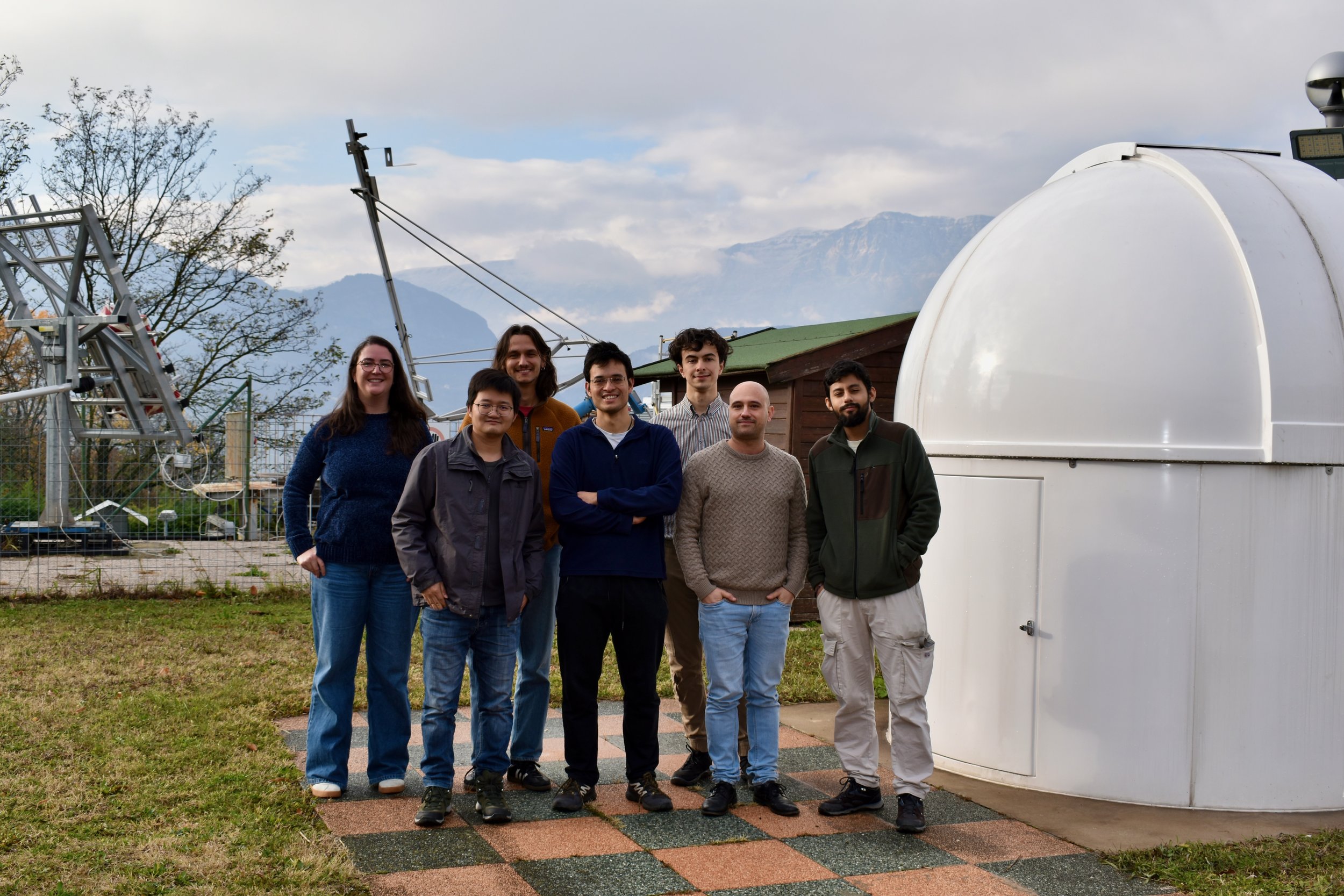
JOIN THE GROUP
Are you a bright student or postdoc interested in joining my group and working with me? Before reading anything else, please read the “General important information” section carefully, as it explains how I work and what I value. If, after doing so, you still haven’t changed your mind, you can consult the section relevant to your level of seniority (postdoc, PhD, MSc, or BSc), and get in touch if you feel there is a good fit. At the end you can also find information on hosting PI-level individual grants (e.g. ERC, FIS, Montalcini).
GENERAL IMPORTANT INFORMATION
Unlike most of my colleagues, I am not interested in maximising group size, headcount, and so on. Likewise, I could not care less about things a lot of academics care about like promotions, academic fame, legacy building, or maximizing invitations to talks. What I care about work-wise is to work on fun, impactful problems with few, highly selected exceptional researchers with whom I have strong scientific and personal affinity, and in a way which is personally sustainable. My mentoring style is therefore deliberately hands-off, and I work best with those who are highly independent and self-driven. This does not mean I am disengaged: while I do not micromanage or provide close or continuous guidance, I am always keen to take part in deep scientific discussions, focusing on ideas, physical interpretation, and strategy, rather than routine debugging (note: I do that too!). This approach is also motivated by the nature of theoretical physics itself, which is hard. My own training was very much a sink-or-swim experience, and while I recognize that this does not suit everyone, it has shaped how I work and how I mentor. In other words: it’s not “you’re on your own, good luck”, but rather “I don’t manage you, I collaborate with you”.
Besides following from how I was trained, much of my mentoring and collaboration structure reflects the need to work within a highly organised and carefully planned schedule. I plan my professional time significantly in advance, often months or years ahead, and must be very deliberate in how I allocate both my time and, especially, my attention. This level of structure and predictability is essential for my brain to work effectively, and for me to manage my attention and cognitive load. Maintaining stable cognitive context and sustained focus, and minimising unplanned demands on attention, are essential for me to work effectively.
Beyond the above scientific and this-is-how-my-brain-functions points, I place a high value on work–life balance, admittedly with a strong emphasis on the life side (see also here for more information). To put it bluntly, I work to live, not the other way around. I treat my job as, at most, a 9–16 office job, and I organise my professional life accordingly. I am aware that this is not how most scientists work: however, I am not most scientists, and since this approach has worked well for me so far, I see no reason to change it.
As a consequence of all the above, I am not actively looking to build a large group or, especially, recruit an army of students for the sake of growth. I take on very few people in my group, and only when there is a clear scientific rationale and strong mutual fit. This is a conscious choice. That being said, once someone joins my group, I am fully invested in their scientific and professional development, while respecting their time and strongly encouraging a healthy work-life balance. And yes, we also have fun doing science (most of the time)! Therefore if you are an exceptional researcher or student, the scientific and personal fit is good, and most importantly none of the above has put you off, I would be genuinely happy to welcome you to my group! 😉
POSTDOCS
TL;DR: if you are truly exceptional, I will hire you if I can and, rather than micromanage, give you huge freedom to do real physics (with or without my direct involvement), trust, and serious scientific collaboration when this is mutually desired (i.e. never forced or imposed).
My approach to postdoctoral mentoring is deliberately hands-off, with strong emphasis on independence and originality, and close collaboration arising when mutually desired. I am always interested in hiring exceptional postdoctoral researchers, subject to availability of external funding, as postdoctoral positions in Italy are typically supported through personal grants rather than University-wide schemes. When I have funding and am actively recruiting, I will advertise an expression of interest (EoI) on INSPIRE-HEP, with material submitted via AJO. Candidates should take the EoI very seriously, in particular the cover letter. Given the difficulty in attracting top candidates to Italy, I ask applicants to explain their motivation for coming despite the comparatively low salaries: personal (non-scientific) motivations are explicitly welcome. In Italy, postdoctoral hiring usually cannot take place directly via AJO, and requires an official public selection (“concorso”): the EoI is not a formal application, but is used to identify candidates who will be subsequently invited to apply to the concorso. While this is formally open, the EoI is the relevant stage for assessing mutual interest.
There are several other opportunities to join my group through independent fellowships. I actively support applications for Marie Skłodowska-Curie (MSCA) postdoctoral fellowships, both European (2 years in Trento) and Global (2 years outside the EU - typically in North America - and 1 in Trento). I have extensive experience with the scheme, having supervised many applications and having won one myself in 2022, and UniTN’s research support office provides excellent support. Applications typically close in September, with projects starting usually one year later. Writing a competitive proposal requires a huge time commitment, so I can only support a very limited number of proposals each year. Interested candidates should thus contact me well in advance, ideally no later than February.
The CARITRO Foundation, a private foundation operating in the Trentino region, also offers highly competitive postdoctoral fellowships every year. These are 2-year positions which provide full independence and a generous salary, and require the submission of a detailed research proposal (similar in sprit to MSCA, but with fewer constraints). Projects are required to bring measurable benefits to the Trentino region, which for theoretical work can typically be achieved through a strong outreach component in collaboration with local institutions. Because funding is limited and each Department at UniTN can support at most 2 applications, these fellowships are highly selective. Interested candidates should therefore contact me well in advance and monitor the foundation’s calls (“bando post-doc”).
In addition to the above opportunities, many countries offer national postdoctoral fellowship schemes that support long-term research stays abroad. These are for all intents and purposes postdoctoral positions, often with extremely competitive salaries, and typically restricted to nationals or to researchers who completed their PhD in that country. These vary substantially in structure, duration, and eligibility, but I am generally happy to support extremely strong candidates who wish to join my group through these schemes, provided the fellowship has a duration of at least 2 years. Shorter ones do not allow sufficient time for impactful work. I reserve full discretion in deciding whether to support externally funded fellowships, subject to institutional, legal, and ethical constraints.
The process of identifying relevant schemes and ensuring they meet all eligibility and mobility requirement is sole responsibility of the candidate, and part of the expected level of independence for postdoctoral researchers. If you are interested in applying for one of these schemes, please contact me at least 4 months before the deadline, as supporting a competitive application requires a significant time commitment, and several bureaucratic steps to clear. Examples of such schemes include:
* Sweden: VR international postdoc grant, Blanceflor Foundation
* Japan: JSPS overseas research fellowship
* Canada: Canada postdoctoral research award program
* Switzerland: SNSF Postdoc.Mobility fellowship
* Germany: DAAD PRIME, Fedor Lynen research fellowship
* Denmark: Carlsberg international fellowship
* Estonia: ETAG mobility funding
* Netherlands: NWO Rubicon
* Norway: FRIPRO
* Austria: FWF Erwin Schrödinger fellowship
* Taiwan: postdoctoral research abroad program
This list is not exhaustive and is meant to illustrate the range of national mobility schemes that may be relevant.
PHD STUDENTS
Admission to the PhD programme at UniTN is through a centralised public selection (“concorso”). Compared to the USA and Northern Europe, the process starts relatively late: applications typically open in April/May, interviews take place in June/July, and offers are made in June/July for a start date of November 1. Interested candidates should keep the Physics PhD programme webpage monitored closely during the application period.
There are two types of PhD positions at UniTN: a) topic-specific positions funded by dedicated grants, and b) open positions funded by UniTN or INFN scholarships. I usually do not offer topic-specific positions, so interested candidates should apply for open positions. In the admission call, these are usually labelled “University of Trento” or “INFN” in the financer column. For INFN, the relevant choice in the possible reserved topic column is “Particle, astroparticle, nuclear, theoretical physics, related technologies and applications, including medical physics”. Each year there are typically between 6 and 9 such open positions in total. These are highly competitive, attract the strongest applicants (mostly theorists), and have very low success rates. Most previous PhD students of the Theoretical Gravitation and Cosmology Group were funded by UniTN or INFN scholarships.
If you are nevertheless interested in working with me, this should be made very clear in the required statement of purpose (“lettera motivazionale”). The admission process is organized at the departmental level, and I generally have no direct role in admission decisions, except when serving on the admissions committee. As a result, unsolicited enquiry emails are generally of limited use. That said, if you are an extremely strong applicant with a genuine interest in working with me, it can help both me and your case if you write a short and focused email outlining your background and interests (see here for how not to do this). Due to the high volume of enquiries and the fact that I do have a life, lack of response should almost always be interpreted as lack of interest. For the reasons explained in the “General important information” section above, I take at most one new PhD student per year, but typically much fewer.
In terms of background, PhD students working with me need to have exceptional preparation in cosmology (especially cosmological perturbation theory, the CMB, and large-scale structure), be comfortable with Python (ideally C/C++ too), and not be afraid of tackling numerical calculations and simulations. Work on black hole physics requires, in addition to the obvious strong familiarity with the subject, also experience with Mathematica. More generally, to thrive under my mentorship, PhD students must be extremely independent and self-driven. If this is not the case, working with me is unlikely to be a good experience (to say the least) for both of us.
MSc students
If you wish to carry out your MSc thesis under my supervision, you must have attended my Modern Cosmology MSc course, and performed exceptionally well, with a final grade of at least 29/30. Grades above 28/30 are awarded only to students who demonstrate strong critical thinking and the ability to apply conceptual tools in contexts beyond the material covered in lectures, skills which are essential prerequisites for working with me. If you meet these requirements, please contact me after passing your exam. For the reasons explained in the “General important information” section above, I supervise only a very small number of MSc students at any given time (no more than 2, at most 3 in truly exceptional cases). Supervision is deliberately hands-off, with meetings taking place no more than once every two weeks, so successful MSc students must be highly independent and self-driven to thrive under my supervision. If you feel that you would benefit from close or frequent guidance, this supervision style is likely not appropriate for you and you should consider working with a different supervisor. This is not meant to scare you or discourage interest, but to set clear and transparent expectations from the outset.
bsc students
If you wish to carry out your BSc thesis under my supervision, you must have attended my Relativity BSc course, and performed exceptionally well, with a final grade of at least 29/30. Grades above 28/30 are awarded only to students who demonstrate strong critical thinking and the ability to apply conceptual tools in contexts beyond the material covered in lectures, skills which are essential prerequisites for working with me. If you meet these requirements, please contact me after passing the exam. At UniTN, a theoretical BSc thesis is meant to be a review-based project (no original research) worth 3 credits, so the time investment on both sides is therefore necessarily limited. Supervision will therefore consist of only very few meetings to discuss the reading material and provide feedback on the final thesis. For this reason, students must be highly independent and self-driven to work successfully under my supervision. If you feel that you would benefit from close or frequent guidance, this supervision style is likely not appropriate for you and you should consider working with a different supervisor. This is not meant to scare you or discourage interest, but to set clear and transparent expectations from the outset.
HOSTING OF INDEPENDENT RESEARCHERS
In addition to supervised positions (postdoctoral and student roles), I strongly support applications for grants such as those of the European Research Council (ERC), Fondo Italiano per la Scienza (FIS), and Rita Levi Montalcini Programme, hosted at UniTN. These are PI-level schemes, not positions within my group, and typically lead to tenure-track-level (RTT) appointments. In this context, I would act as internal sponsor, and we would work in close connection within the Theoretical Gravitation and Cosmology Group. Internal support at the application stage is essential: securing one of these grants and then requesting hosting without a sponsor and departmental support will generally not work. For this reason, and because I only support proposals closely aligned with my research interests, candidates considering bringing one of these grants to UniTN should contact me as early as possible.
By contrast, for the reasons explained in the “General important information” section above, I do not encourage unsolicited visits or generic enquiries aimed at exploring vague ideas and informal brainstorming, or short-term exploratory visits. Because of how I function, unstructured visits, frequent interruptions, or loosely defined interactions are extremely disruptive and carry a disproportionately high cognitive cost for my brain. Unless we are already collaborators, or there is a clear, concrete, and well-defined project or funding opportunity (of at least 2 years duration, as outlined in the “Postdocs” section above), I cannot generically support such requests. This applies in particular to students. I frequently receive enquiries about internships, short-term research projects, visiting positions, and similar arrangements. With very rare exceptions, and unless there is a pre-existing research relationship (in any case with no more than a degree of academic separation, i.e. your supervisor and I are close collaborators), the answer is invariably no. My priority as a UniTN faculty member is to supervise UniTN students, and I do not have the capacity to support short-term, unstructured, or exploratory visits.