My paper with Marco Calzà, Davide Pedrotti, and Max Rinaldi, where we study evaporating cosmologically coupled BHs (see this earlier news item), has now officially been published in PRD! The full bibliographic coordinates for the paper are Phys. Rev. D 114 (2026) 084014. Here is the link to the paper (which is published Open Access).
Evaporating cosmologically coupled black holes paper accepted in PRD!
My paper with Marco Calzà, Davide Pedrotti, and Max Rinaldi, where we study evaporating cosmologically coupled BHs (see this earlier news item), has been accepted for publication in PRD! There were minor changes compared to the earlier version, mostly to better explain the regime of validity of our approximations. You can read the preprint version of our paper on arXiv: 2607.13857.
Evaporating cosmologically coupled black holes
Very happy to see my new paper with Marco Calzà, Davide Pedrotti, and Max Rinaldi out today, making it yet one more paper 100% produced within the Theoretical Gravitation and Cosmology Group led by myself and Max! We study cosmologically coupled black holes (CCBHs), which have gained tremendous interest recently, including as possible candidates for driving cosmic acceleration. All studies on CCBHs so far were purely classical, and neglected the fact that CCBHs will inevitably evaporate: we therefore asked ourselves how evaporating CCBHs would behave. After discussing in detail how evaporating CCBHs can be modelled (which in turn required us to adopt a controlled quasi-adiabatic approxiation), we showed that these objects can have a very rich phenomenology, and we derived the first constraints on their abundance. You can read our results in the preprint we just posted on arXiv: 2607.13857.
Admissions for PhD in Physics in Trento!
The University of Trento welcomes applications for admission to the 42nd cycle of the PhD in Physics, for positions starting on November 1, 2026 (see here for Italian link, here for English link, scroll to “Bando di ammissione” and “Admission call” respectively, and here for much more detailed information): this year we have a total of 19 positions, 15 of which with scholarship, and 4 of which are “open positions”, i.e. not tied to any specific topic. Applicants interested in working within the Theoretical Gravitation and Cosmology group should note that I do not plan on taking PhD students this year, so there is little point applying and expressing interest in working with me. On the other hand, Prof. Rinaldi would be interested in taking a PhD student to work on cosmologically coupled black holes, see here for more information. Applicants interested in working with Prof. Rinaldi would be competing for these 4 “open positions” (those referred to as “University of Trento” in the Table on Page 2 of the admission call) - however, another possible channel in this direction is to apply for one of the 2 INFN funded-positions (Section “F, G - Particle, astroparticle, nuclear, theoretical physics, related technologies and applications, including medical Physics”), which are de facto “open positions” and in the past have funded PhD students in our group. Competition for these open positions is extremely strong, with an oversubscription ratio much higher than for the other (reserved) positions: therefore, if you are interested in working with Prof. Rinaldi, please make this very clear in your “lettera motivazionale” (“statement of purpose”), which plays an extremely important role in the evaluation of candidates, so please take it very seriously. The application deadline is May 19, 2026 at 16:00 Italy time, but interested applicants are strongly encouraged to apply well in advance of the deadline.
Visit by Kevin Croker
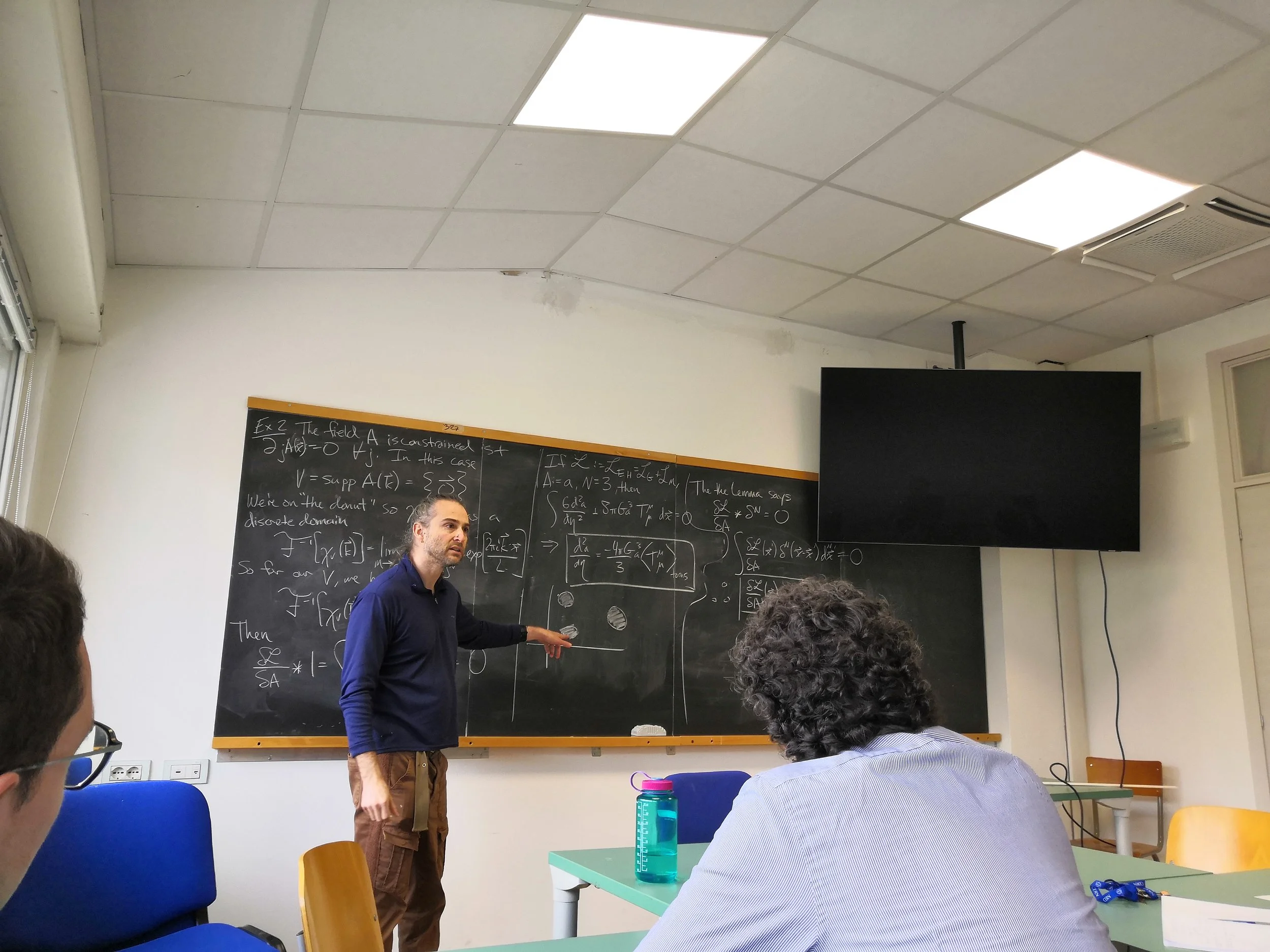
For the rest of the month we have the great pleasure of hosting Kevin Croker, currently an Assistant Research Scientist at Arizona State University. Kevin is especially well known for his work on cosmologically coupled black holes. He will be delivering a few lectures on the topic, specifically on constrained variations and their impact on cosmological dynamics. Welcome Kevin!
Stochastic gravitational wave background from cosmologically coupled black holes paper published in Scientific Reports!
My paper with Marco Calzà, Francesco Gianesello, and Max Rinaldi, where we study the stochastic gravitational wave background signal resulting from inspiraling cosmologically coupled BHs (see this earlier news item), has now officially been published in Scientific Reports (making this my third proper Nature publication)! The full bibliographic coordinates for the paper are Sci. Rep. 14 (2024) 31296. Here is the link to the paper (which is published Open Access).

Stochastic gravitational wave background from cosmologically coupled black holes paper accepted in Scientific Reports!
My paper with Marco Calzà, Francesco Gianesello, and Max Rinaldi (proudly 100% made within the Theoretical Gravitation and Cosmology Group led by myself and Max!) , where we study the stochastic gravitational wave background signal resulting from inspiraling cosmologically coupled BHs (see this earlier news item), has been accepted for publication in Scientific Reports, part of the Nature Portfolio collection of journals (therefore making this my third proper Nature publication)! With respect to the earlier version we have slightly changed the title and explained the content of Fig. 2 much more clearly, but the main message of the paper is otherwise unchanged. You can read the preprint version of the paper on arXiv: 2409.01801.

Stochastic gravitational wave background from cosmologically coupled black holes
Very happy to see my latest paper with Marco Calzà, Francesco Gianesello, and Max Rinaldi out! This is a 100% “made in Trentino” paper, and more precisely made within the Theoretical Gravitation and Cosmology Group led by myself and Max. At some point in 2023, the possibility that dark energy could be sourced by cosmologically coupled black holes (BHs), whose mass increases in time through purely cosmological growth even in the absence of accretion and merger events, received a lot of interest, especially given the possibility that signatures of such a coupling could have been observed in the growth of supermassive BHs in red-sequence elliptical galaxies. In today’s paper we show that mergers of such cosmologically coupled BHs would lead to a stochastic gravitational wave background whose strength is significantly larger (up to an order of magnitude stronger!) than the standard one from mergers of uncoupled BHs, with very interesting implications for the signal observed last year by pulsar timing arrays (among which NANOGrav, EPTA, PPTA, and CPTA), which is a bit too strong to be easily explainable by mergers of standard BHs. You can read our results in the preprint we just posted on arXiv: 2409.01801.
