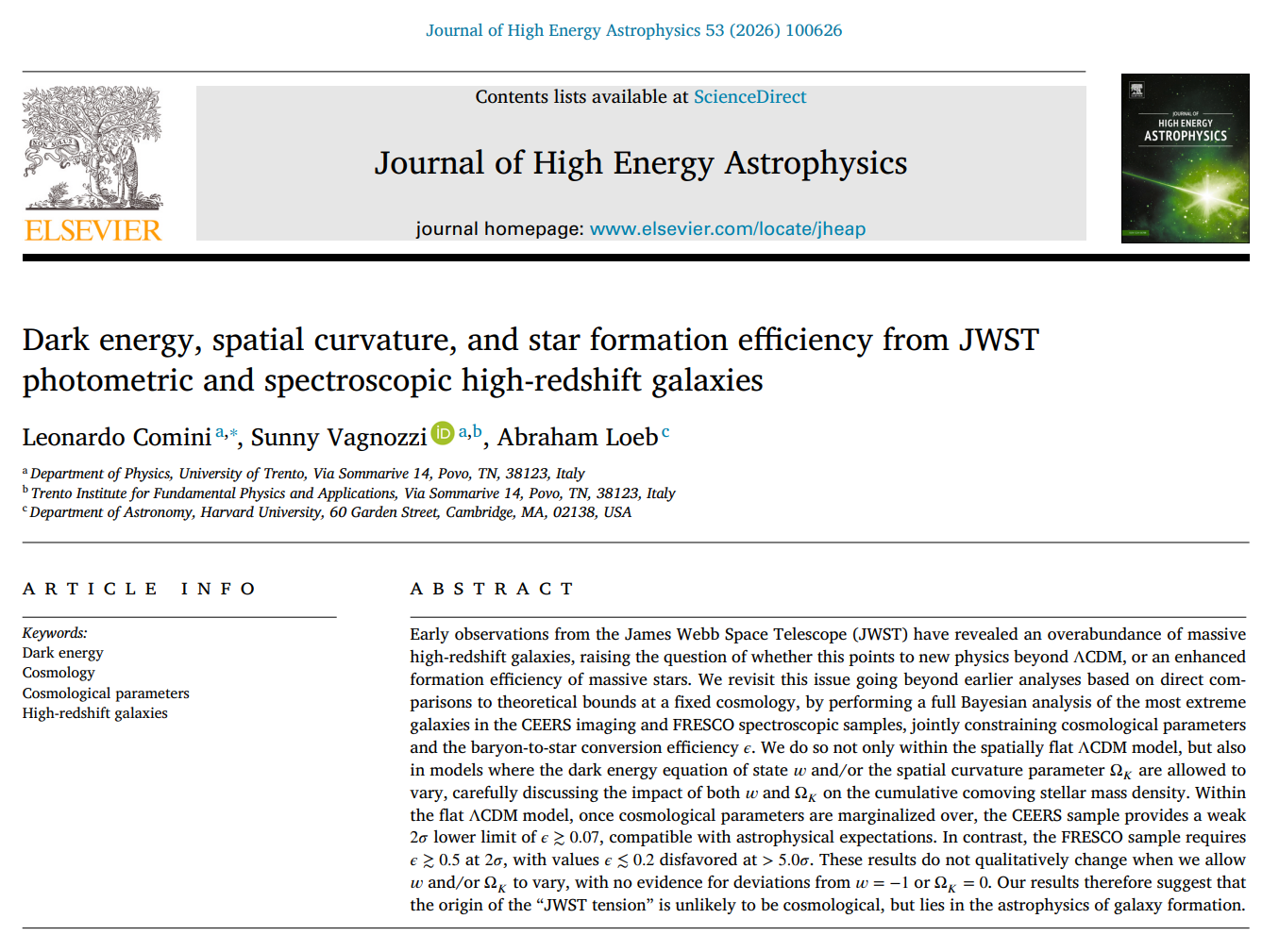
My paper with Leonardo Comini and Avi Loeb, where we revisit the “JWST tension” in models beyond ΛCDM and with spectroscopic data (see this earlier news item), has now officially been published in JHEAp! The full bibliographic coordinates for the paper are JHEAp 53 (2026) 100626. Here is the link to the paper (which is published Open Access).
Beyond ΛCDM with JWST paper accepted in JHEAp!
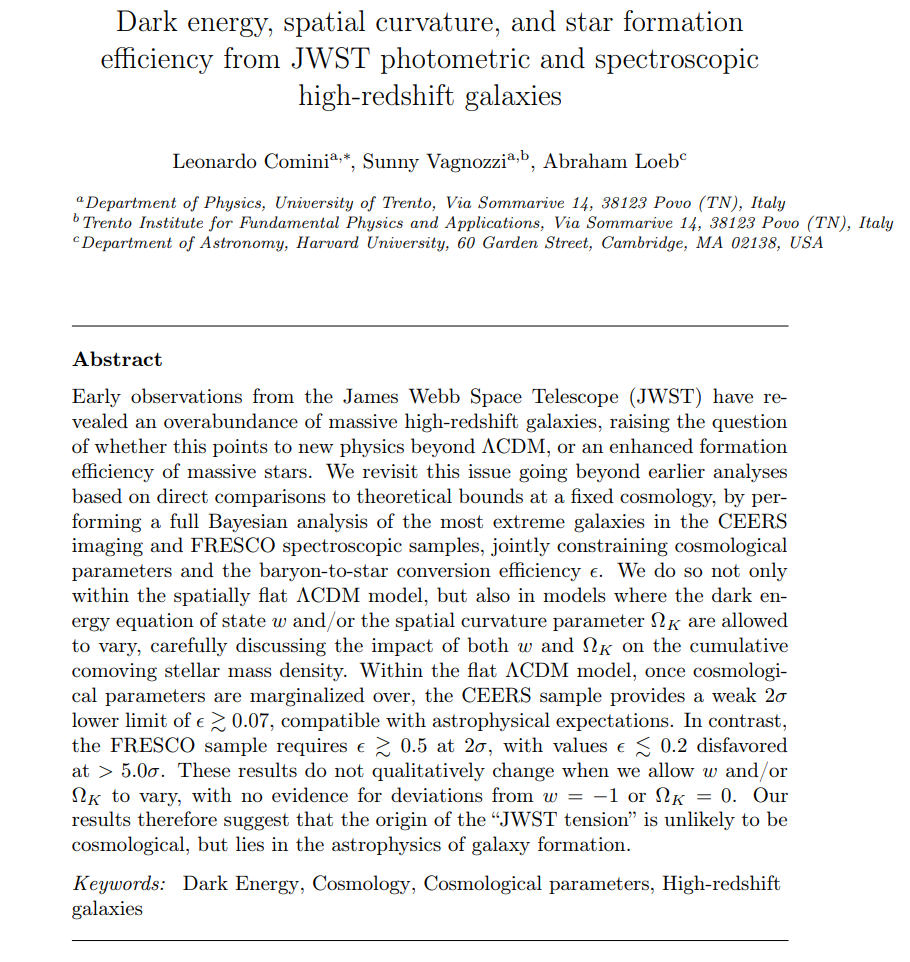
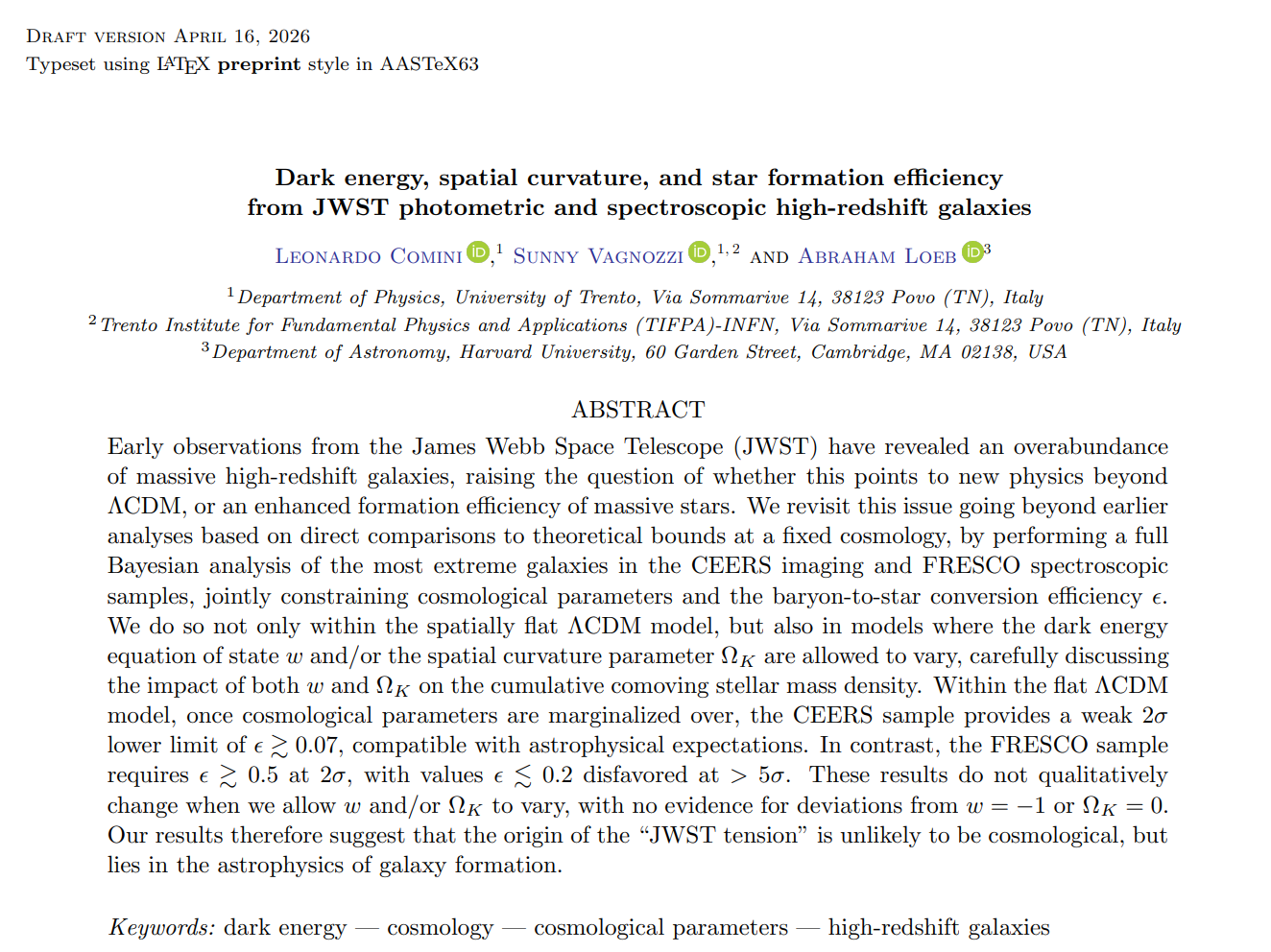
My paper with Leonardo Comini and Avi Loeb, where we revisit the “JWST tension” in models beyond ΛCDM and with spectroscopic data (see this earlier news item), has been accepted for publication without changes in JHEAp! You can read the preprint version of our paper on arXiv: 2604.13866.
Beyond ΛCDM with JWST
I’m very happy to see my latest paper with my former MSc student Leonardo Comini and Avi Loeb out on arXiv - congratulations to Leonardo who did a significant part of the work, in what is basically the result of his MSc thesis! This work is basically an extension of Mike Boylan-Kolchin’s 2023 paper arguing that early JWST photometric data put significant pressure on the ΛCDM model. We basically asked the question of how this result changed if: 1) a proper Bayesian analysis was carried out, 2) considering also models beyond ΛCDM (e.g. models with a free equation of state or spatial curvature), and 3) using also spectroscopic data which is more reliable? The answer is that carrying out this analysis photometric data actually no longer requires an unusually high star formation efficiency, unlike (surprisingly) spectroscopic data, with the results not changing significantly in models beyond ΛCDM: the conclusion is that the origin of the “JWST tension” is likely astrophysical rather than cosmological. You can read the results in the preprint we just posted on arXiv: 2604.13866.
Leonardo Comini’s MSc defense
Congratulations to Leonardo Comini, who today successfully defended his MSc thesis, by the title of “Testing cosmological models with JWST high-redshift galaxies” (with the opponent being Prof. Albino Perego), receiving the final grade of 110/110! In his thesis which I supervised, Leonardo studied the possibility of testing cosmological models (focusing on dark energy) in a statistically robust way using high-redshift galaxies from JWST, focusing both on photometric and spectroscopic samples, and finding that despite the relatively large error bars some of these samples can indeed give interesting cosmological information. We are planning to write up our results in a paper relatively soon, so stay tuned for more!

Negative cosmological constant and JWST (part 2)
Together with Nicola Menci, Shahnawaz Adil, Upala Mukhopadhyay, and Anjan Sen, today we posted a new preprint which is basically the sequel to our earlier negative cosmological constant and JWST paper published in JCAP. What we did here, in no small part thanks to Nicola’s contribution, was to perform a more thorough analysis of JWST data, which significantly strengthens our earlier conclusions and shows that a dark energy model featuring a negative cosmological constant is a very interesting candidate model in light of the JWST observations. One notable addition was our study not only of photometric observations, but also spectroscopic observations from the FRESCO survey, which again confirm the earlier results and at the same time make them much more robust. It was great fun working on this paper, and I learned a lot about high-redshift galaxies! You can read our results in the preprint we just posted on arXiv: 2401.12659.

Negative cosmological constant and JWST observations of high-redshift galaxies
Last summer, early observations from the James Webb Space Telescope (JWST) caused quite a stir due to their discovery of a puzzlingly abundant population of extremely massive galaxies at too high redshift, too many to have been in place if the ΛCDM model as we understand it is correct. In today’s new preprint with Shahnawaz Adil, Upala Mukhopadhyay, and Anjan Sen (all three from JMI, and kudos to Shahnawaz and Upala who did all the heavy-lifting!) we study whether these results could be explained by a dark energy model beyond the cosmological constant. In particular we consider a model featuring a negative cosmological constant (anti de Sitter vacuum) with an evolving component (whose energy density is of course positive) on top - this model is phenomenologically motivated from string theory considerations, particularly the swampland program, and the difficulty in constructing consistent de Sitter string vacua. We show that such a model can dramatically alter structure formation and potentially explain how the galaxies seen by JWST could have been in place much earlier than is allowed within ΛCDM. You can read our results in the preprint we just posted on arXiv: 2307.12763.
