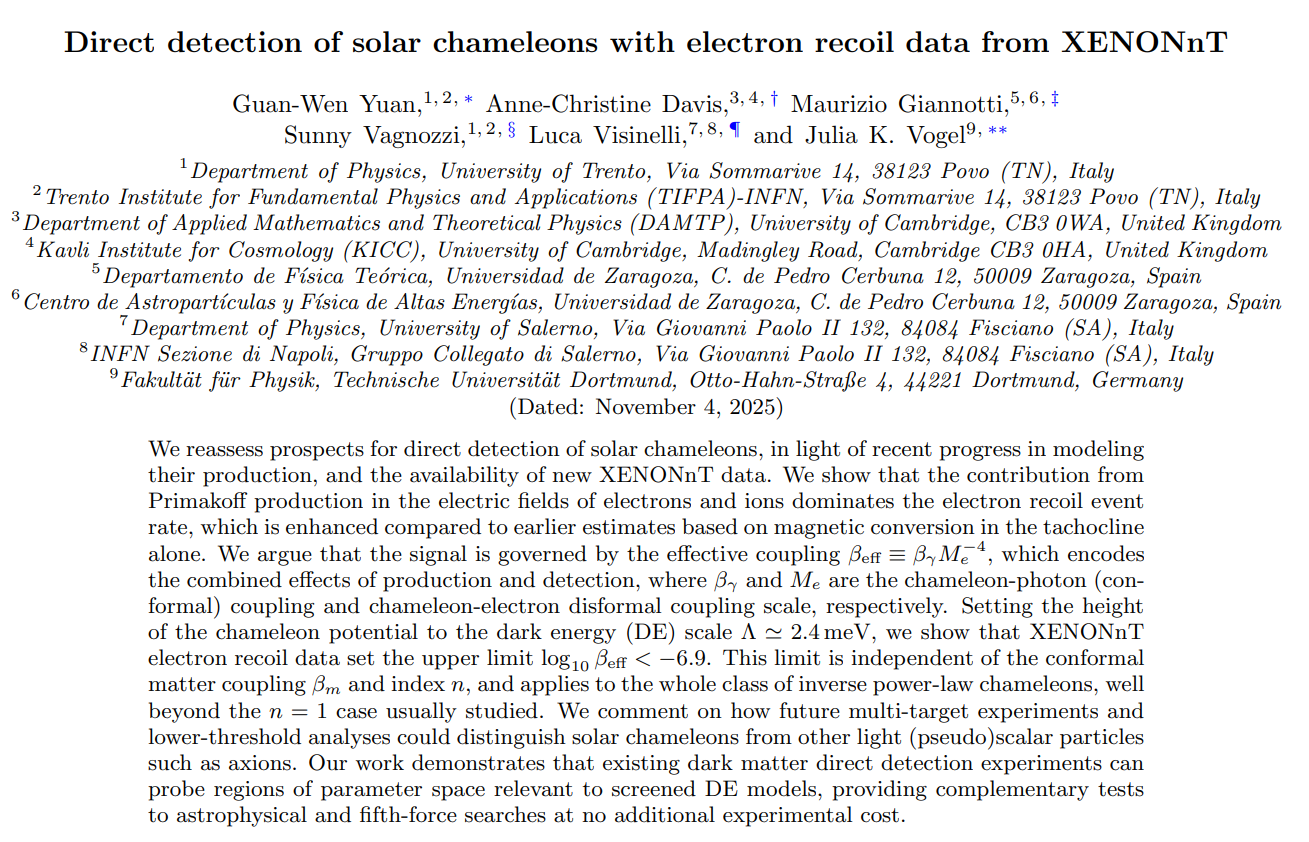
My paper with Guan-Wen Yuan, Anne Davis, Maurizio Giannotti, Luca Visinelli, and Julia Vogel, where we set new constraints on solar chameleons from XENONnT electron recoil data (see this earlier news item), has now officially been published in PRD! The full bibliographic coordinates for the paper are Phys. Rev. D 113 (2026) 123024. Here is the link to the paper (which is published Open Access).
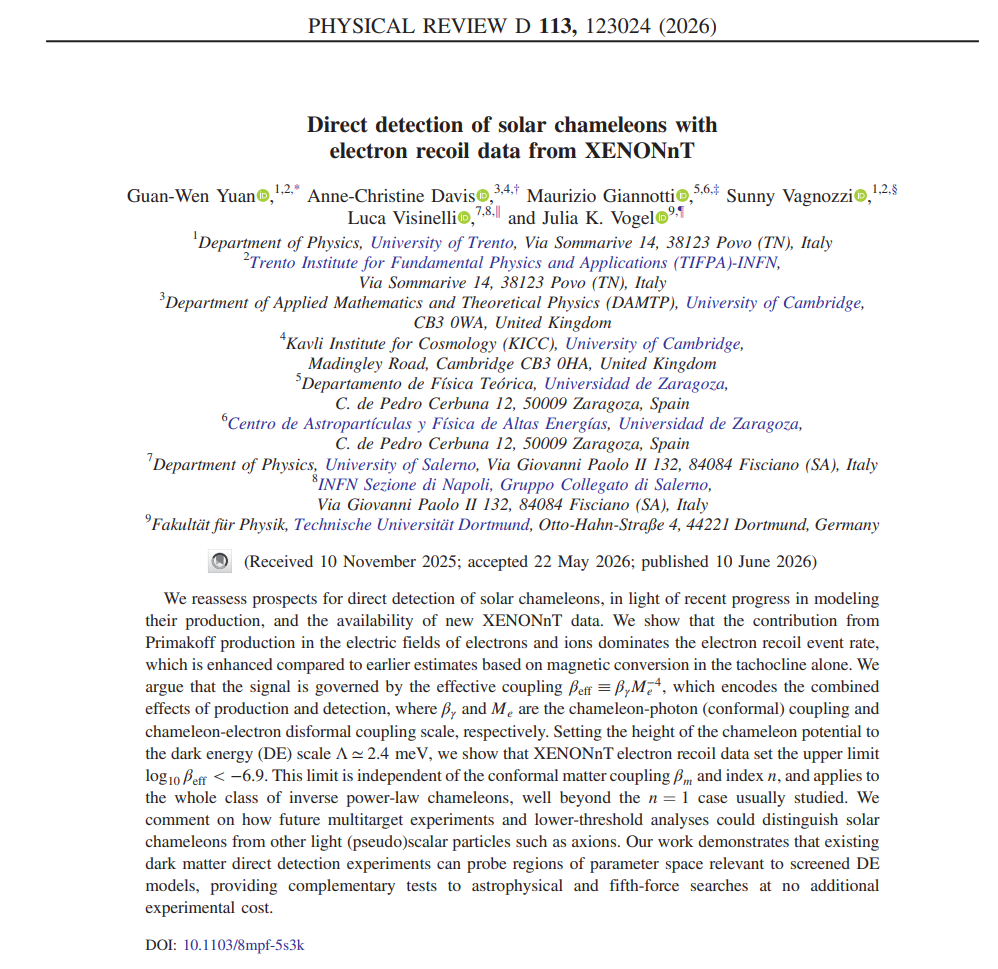
Solar chameleons and XENONnT paper accepted in PRD!
My paper with Guan-Wen Yuan, Anne Davis, Maurizio Giannotti, Luca Visinelli, and Julia Vogel, where we set new constraints on solar chameleons from XENONnT electron recoil data (see this earlier news item), has been accepted for publication in PRD! There were relatively minor changes compared to the earlier version, especially concerning the publicly available code. You can read the preprint version of our paper on arXiv: 2511.01655.
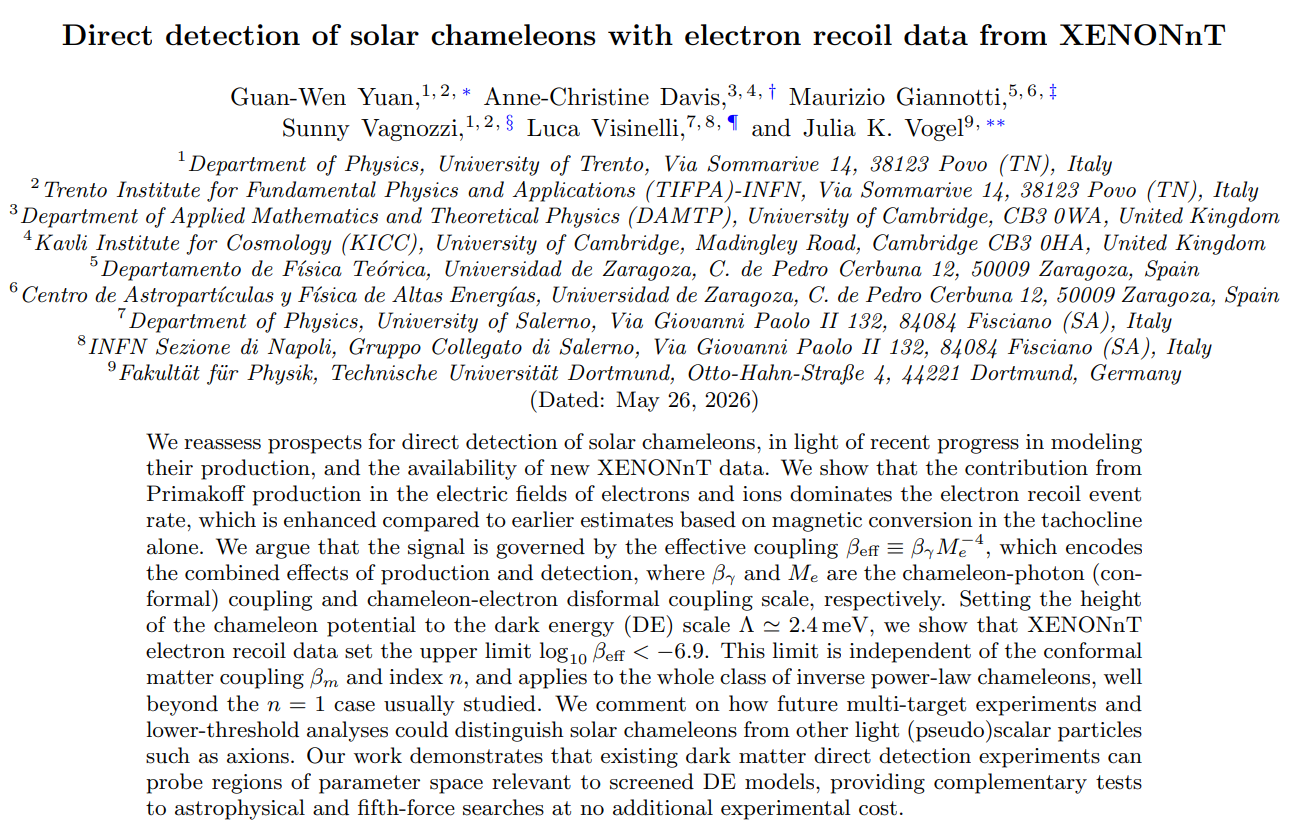
Solar chameleons and XENONnT
Very happy to see my latest paper with Guan-Wen Yuan, Anne Davis, Maurizio Giannotti, Luca Visinelli, and Julia Vogel out on arXiv - kudos to Guan-Wen who did all the heavy lifting! This paper is essentially a merger of two previous papers of mine: in 2021 Luca, Anne, and I argued that dark matter direct detection experiment such as XENON1T could detect chameleons, light particles potentially related to dark energy, produced in the Sun (see paper in PRD), whereas later in 2024 some of us drastically improved the model for solar chameleon production, which was previously grossly incomplete to say the least (see paper in PRD and this earlier news item). What we did here was to combine the tools built in these two papers, applying the results to newer and much more sensitive data from XENONnT, and confirming the extremely important message that terrestrial dark matter experiments are well suited to probe screened dark energy at no extra experimental cost. We clarified various previously unclear points, and derived a new upper limit on a combination of chameleon couplings (specifically the conformal coupling to photons and the disformal coupling to electrons), valid for essentially all values of the chameleon power-law index n, making it one of the most widely applicable chameleon bounds to date. You can read the results in the preprint we just posted on arXiv: 2511.01655.