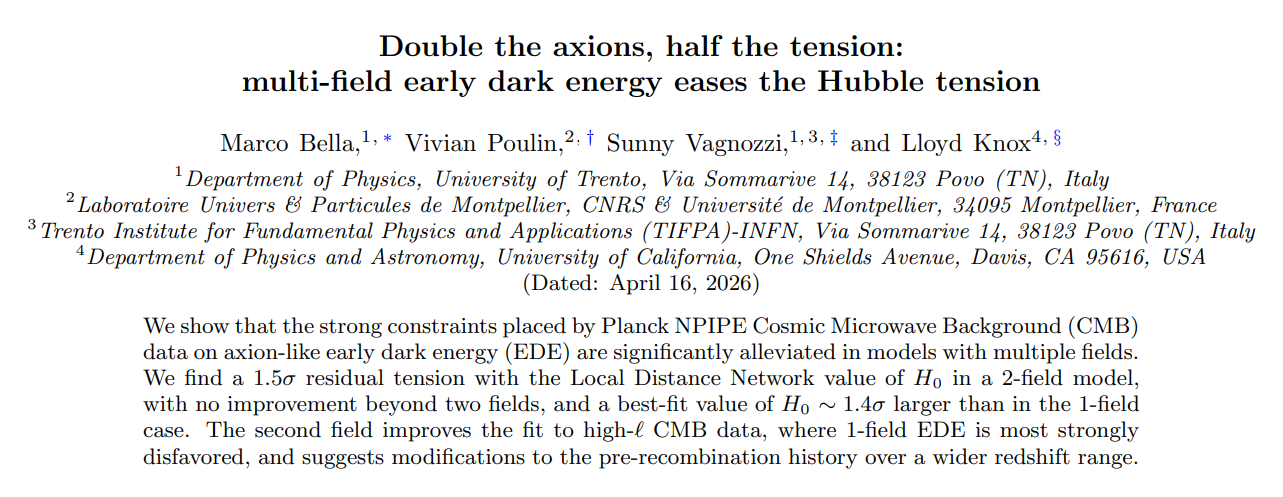
I’m extremely excited to see my latest paper with my outstanding MSc student Marco Bella, Vivian Poulin, and Lloyd Knox out on arXiv - congratulations to Marco who did basically all the work, in what is essentially the result of his MSc thesis! The canonical 1-field axion early dark energy (EDE) model which Vivian and collaborators developed a few years ago faces extremely tight constraints when confronted against Planck PR4 CMB data. In this work we asked ourselves: what happens if we introduce more than 1 axion, a scenario which for instance can be strongly motivated by the string axiverse? The answer is that having 2 axions can significantly help, basically halving the residual Hubble tension even when confronted against Planck PR4 CMB data, whose fit is drastically improved by the fact that the modifications to the expansion history now span a wider redshift range, including the epoch closer to recombination (although, interestingly, having more axions does not seem to improve these results). You can read the results in the preprint we just posted on arXiv: 2604.13535.