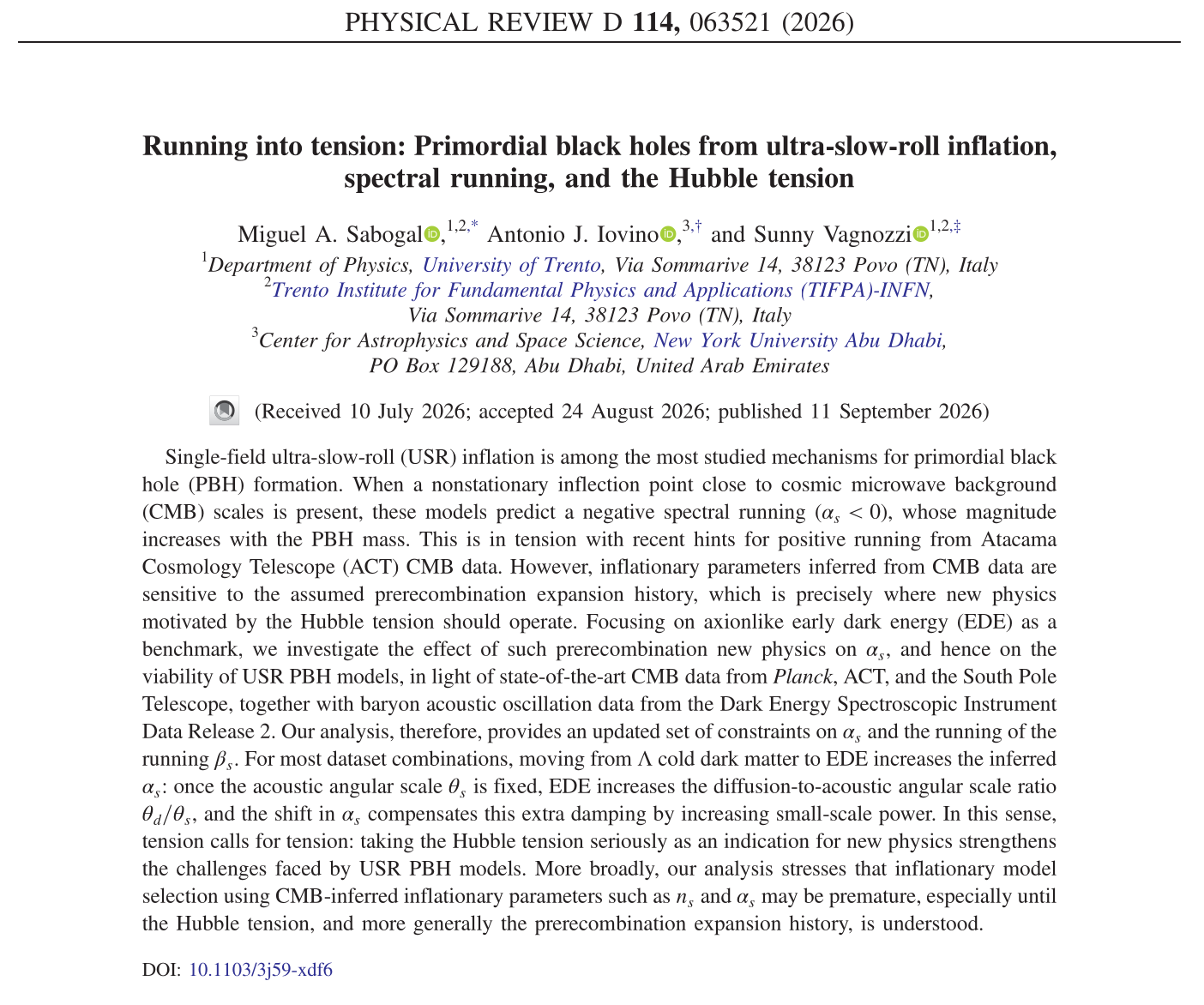
My paper with Miguel Sabogal and Antonio Iovino, where we study the interplay between primordial black holes from ultra-slow-roll inflation, cosmological constraints on the spectral running, and the Hubble tension, while also stressing that inflationary model selection is somewhat premature until the cause of the Hubble tension is well understood (see this earlier news item), has now officially been published in PRD! The full bibliographic coordinates for the paper are Phys. Rev. D 114 (2026) 063521. Here is the link to the paper (which is published Open Access).
Running into tension paper accepted in PRD!
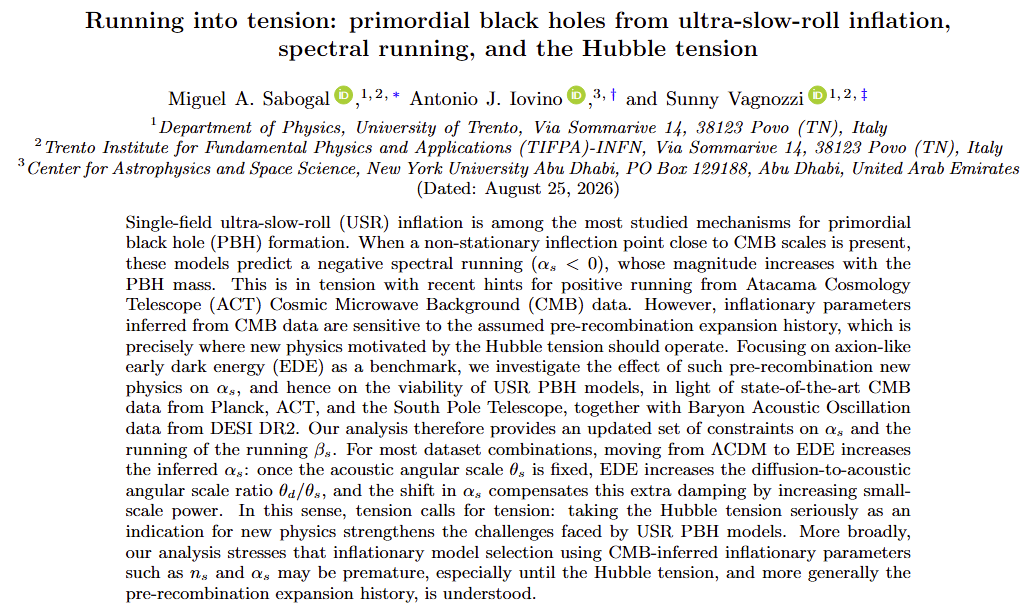
My paper with Miguel Sabogal and Antonio Iovino, where we study the interplay between primordial black holes from ultra-slow-roll inflation, cosmological constraints on the spectral running, and the Hubble tension, while also stressing that inflationary model selection is somewhat premature until the cause of the Hubble tension is well understood (see this earlier news item), has been accepted for publication in PRD! There were minor changes compared to the earlier version (including a new very cool Fig. 1), which better clarified the regime of applicability of our results. You can read the preprint version of our paper on arXiv: 2606.31362.
Running into tension
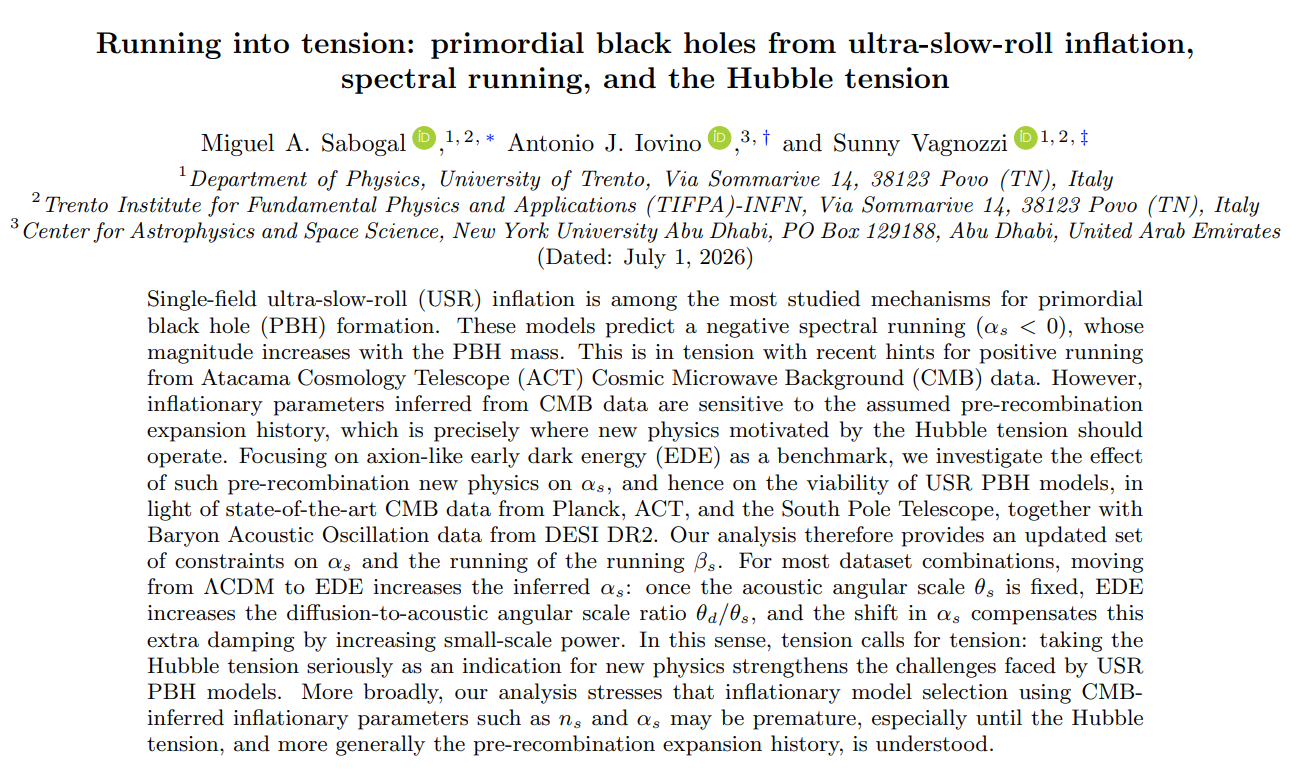
Very happy to see my latest paper with Miguel Sabogal and Antonio Iovino out on arXiv, making this my first paper with my PhD student Miguel! In this paper we start from the observation, pointed out in an earlier work by Antonio and others, that ultra-slow-roll (USR) inflationary models for primordial black hole (PBH) production generically predict a negative spectral running, which is in apparent tension with ACT data. However, inflationary parameters depend quite heavily on the assumed pre-recombination model, and the Hubble tension makes this quite uncertain: we therefore asked what happens if new pre-recombination physics motivated by the Hubble tension is introduced, focusing on axion-like early dark energy. We found that this increases the spectral running, worsening the tension for USR PBH models, a feature which we argue is generic to pre-recombination new physics models introduced to solve the Hubble tension, due to the increased damping; we also took the opportunity to stress once more that inflationary parameters inferred from cosmological observations are model-dependent and should not be interpreted as model-independent measurements of the primordial power spectrum, and that inflationary model selection based on these constraints is somewhat premature until the cause of the Hubble tension is well understood. You can read the results in the preprint we just posted on arXiv: 2606.31362.
Multi-field early dark energy
I’m extremely excited to see my latest paper with my outstanding MSc student Marco Bella, Vivian Poulin, and Lloyd Knox out on arXiv - congratulations to Marco who did basically all the work, in what is essentially the result of his MSc thesis! The canonical 1-field axion early dark energy (EDE) model which Vivian and collaborators developed a few years ago faces extremely tight constraints when confronted against Planck PR4 CMB data. In this work we asked ourselves: what happens if we introduce more than 1 axion, a scenario which for instance can be strongly motivated by the string axiverse? The answer is that having 2 axions can significantly help, basically halving the residual Hubble tension even when confronted against Planck PR4 CMB data, whose fit is drastically improved by the fact that the modifications to the expansion history now span a wider redshift range, including the epoch closer to recombination (although, interestingly, having more axions does not seem to improve these results). You can read the results in the preprint we just posted on arXiv: 2604.13535.
Marco Bella’s MSc defense
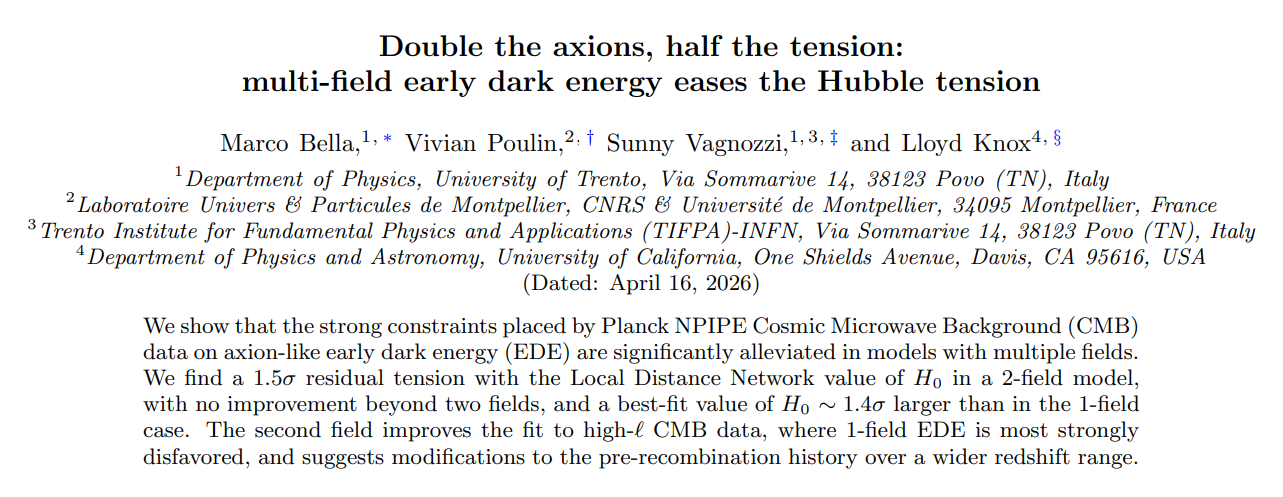
Congratulations to Marco Bella, who today successfully defended his MSc thesis, by the title of “Multi-axion early dark energy and the Hubble tension” (with the opponent being Prof. Albino Perego)! Marco’s defense was absolutely outstanding, and he received top grades and honours, i.e. 110 e Lode (with this being the fourth 100 e Lode for my MSc students, after Davide Pedrotti, Giovanni Piccoli, and Mattia Scotto). In his thesis which I supervised together with Vivian Poulin, Marco studied multi-field axion early dark energy models, with the goal of seeing whether they can further improve over the vanilla early dark energy model in the context of the Hubble tension (as a spoiler, the answer is yes, and we are preparing a paper on the topic to appear soon, so stay tuned!), while developing and publicly releasing the mAxiCLASS Boltzmann solver. Marco will be starting his PhD later this year at UC Davis, where he will be working with Lloyd Knox. During the same day, I also served as opponent for Sara Marini and Jesa Crapella, respectively MSc students of Prof. Albino Perego and Prof. Alessandro Roggero, who discussed theses on binary neutron star mergers and non-superfluid neutron stars.
Early dark energy and massive neutrinos paper published in MNRAS!
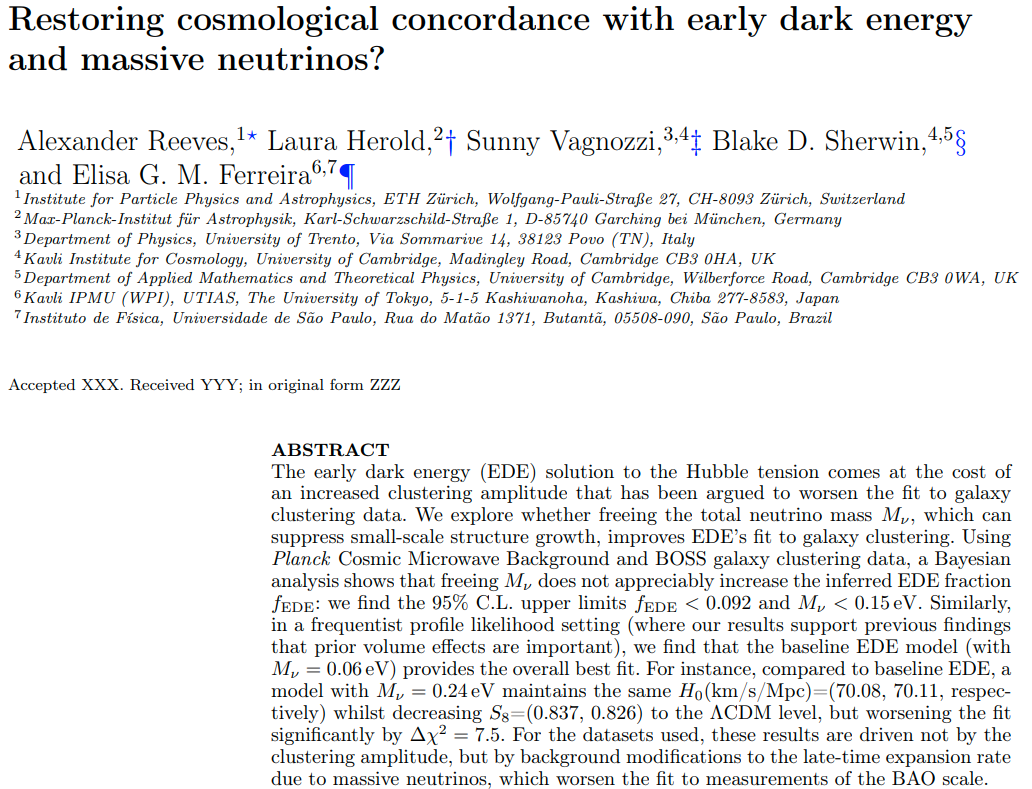
My paper with Alex Reeves, Laura Herold, Blake Sherwin, and Elisa Ferreira on early dark energy and massive neutrinos, which I previously reported on in an earlier news item, has now officially been published in MNRAS! The full bibliographic coordinates for the paper are Mon. Not. Roy. Astron. Soc. 520 (2023) 3688. Here is the link to the paper (which is published Open Access).

Early dark energy and massive neutrinos paper accepted in MNRAS!
My paper with Alex Reeves, Laura Herold, Blake Sherwin, and Elisa Ferreira (a very international collaboration, spanning 6 different countries - Switzerland, Germany, Italy, UK, Japan, and Brazil!), where we study whether a cosmological model featuring early dark energy (EDE) and massive neutrinos can alleviate cosmological tensions in a way which bypasses the potential problems EDE faces with galaxy clustering data, has been accepted for publication in MNRAS! We show that the answer is…“yes and no”, in the sense that our paper really reinforces the idea that prior volume effects are very important for EDE, to the extent that some of those which were previously described as problems, just maybe aren’t really problems in the first place. Kudos to Alex and Laura, two outstanding PhD students (though Laura is off to her first postdoc as a Miller fellow at JHU), who did all the heavy-lifting on this paper! It has been quite a journey, considering this paper was born out of Alex’s MSc thesis (Alex did his Part III in Cambridge with me, Blake, and George Efstathiou), whose project was conceived on a stuffy afternoon of July 2020, deep in lockdown period, while the first referee report was humongous to say the least, but really helped improve the paper! You can find the preprint version of the paper on arXiv: 2207.01501.