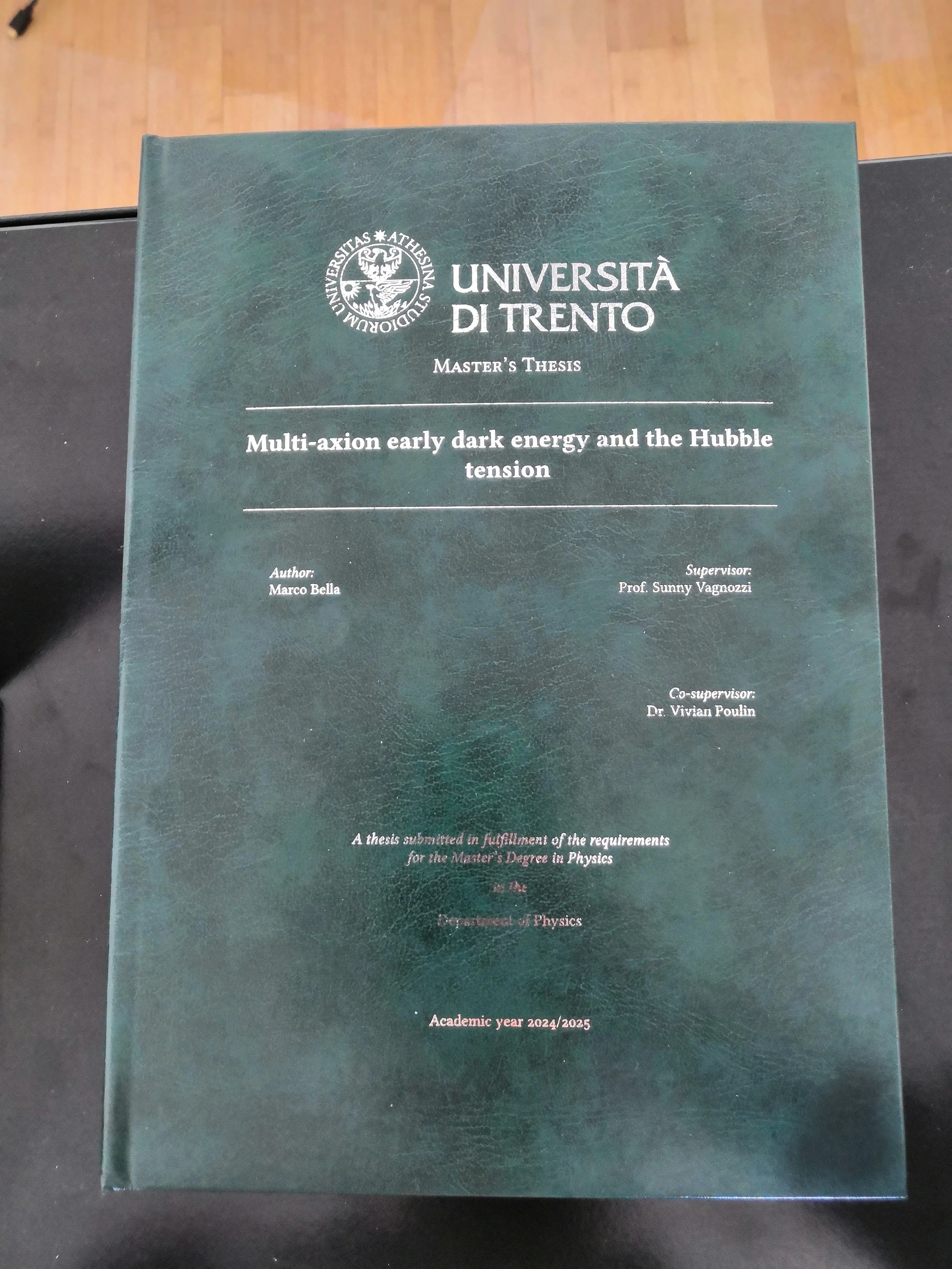
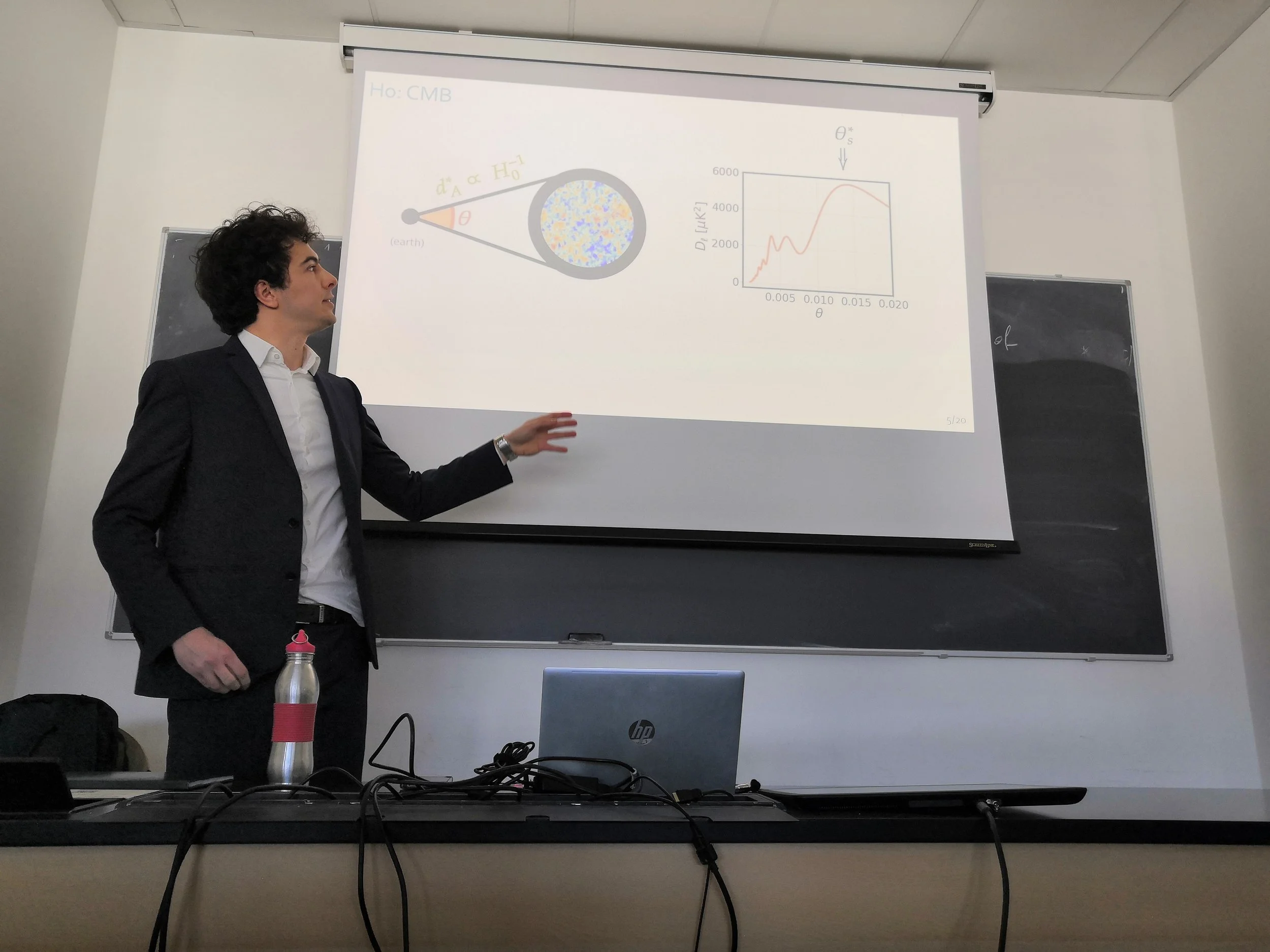
Congratulations to Marco Bella, who today successfully defended his MSc thesis, by the title of “Multi-axion early dark energy and the Hubble tension” (with the opponent being Prof. Albino Perego)! Marco’s defense was absolutely outstanding, and he received top grades and honours, i.e. 110 e Lode (with this being the fourth 100 e Lode for my MSc students, after Davide Pedrotti, Giovanni Piccoli, and Mattia Scotto). In his thesis which I supervised together with Vivian Poulin, Marco studied multi-field axion early dark energy models, with the goal of seeing whether they can further improve over the vanilla early dark energy model in the context of the Hubble tension (as a spoiler, the answer is yes, and we are preparing a paper on the topic to appear soon, so stay tuned!), while developing and publicly releasing the mAxiCLASS Boltzmann solver. Marco will be starting his PhD later this year at UC Davis, where he will be working with Lloyd Knox. During the same day, I also served as opponent for Sara Marini and Jesa Crapella, respectively MSc students of Prof. Albino Perego and Prof. Alessandro Roggero, who discussed theses on binary neutron star mergers and non-superfluid neutron stars.
Mattia Scotto's MSc defense
Congratulations to Mattia Scotto, who today successfully defended his MSc thesis, by the title of “Dark Energy models featuring negative energy densities: growth of structure and novel perturbation-level signatures” (with the opponent being Prof. Albino Perego)! Mattia’s defense was outstanding, and he received top grades and honours, i.e. 110 e Lode (making me a very proud advisor, with this being the third 100 e Lode in a row for my amazing MSc students, after Davide Pedrotti and Giovanni Piccoli). In his thesis which I supervised, Mattia studied dark energy models featuring negative energy density components, including a negative cosmological constant with an evolving component with positive energy density on top, and a sign-switching cosmological constant. He studied in detail the growth of structure, late ISW effect, and signatures in the cross-correlation between CMB temperature anisotropies and galaxy clustering, finding however that current data has too low signal-to-noise for one to search for these signatures. During the same day, I also served as opponent for Arianna Balduzzi, an outstanding MSc student of Prof. Max Rinaldi who defended her thesis studying reheating and preheating in scale-invariant inflation.

Giovanni Piccoli's MSc defense
Congratulations to Giovanni Piccoli, who today successfully defended his MSc thesis, by the title of “The very small-scale primordial Universe: complementary tests from Cosmic Neutrinos and Gravitational Waves” (with the opponent being Prof. Alessandro Roggero)! Giovanni’s defense was simply outstanding, and he received top grades and honours, i.e. 110 e Lode. In his thesis which I supervised, Giovanni developed complementary tests of the small-scale power spectrum of primordial fluctuations using the stochastic gravitational wave background measured by pulsar timing arrays, and forecasting the reach in this sense of a potential future measurement of the cosmic neutrino background (CNB) from laboratory experiments. What does the CNB have to do with the small-scale power spectrum? We’re writing up a paper based on Giovanni’s results, and I can guarantee it will be extremely exciting, so no spoilers!

Davide Pedrotti's MSc defense
Congratulations to Davide Pedrotti, who today successfully defended his MSc thesis, by the title of “Studies on Quasi-Normal Modes and Shadows of Black Holes” (with the opponent being Prof. Albino Perego)! Davide’s defense was outstanding (one of the committee members, a condensed matter physicist, said: “This is the first talk on black holes I’ve understood in years”), and in fact he received top grades and honours, i.e. 110 e Lode. In his thesis, supervised by myself and Prof. Kostas Kokkotas at the University of Tübingen, Davide studied quasi-normal modes and shadows of a number of well-motivated BH metrics beyond GR, and in particular investigated the non-trivial correspondence between the two for metrics describing rotating regular BHs: part of his thesis will be written up in a paper in the coming months, so stay tuned! During the same day, I also served as opponent for an MSc student of Prof. Bill Weber. Davide will now be enjoying a few days of deserved break before starting hiw new adventure as a PhD student in Trento in November.
