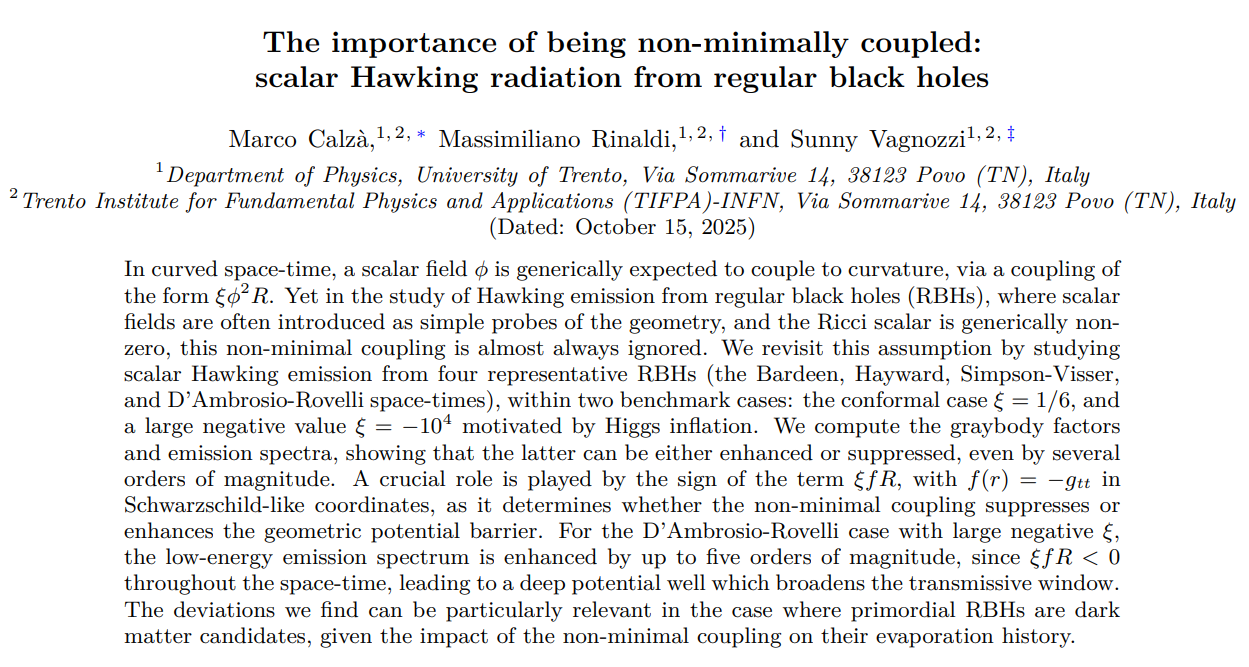
My paper with Marco Calzà and Max Rinaldi, where we study Hawking radiation from regular black holes in the presence of a non-minimal scalar-curvature coupling (see this earlier news item), has been accepted for publication without changes in PRD! You can read the preprint version of our paper on arXiv: 2510.12257.
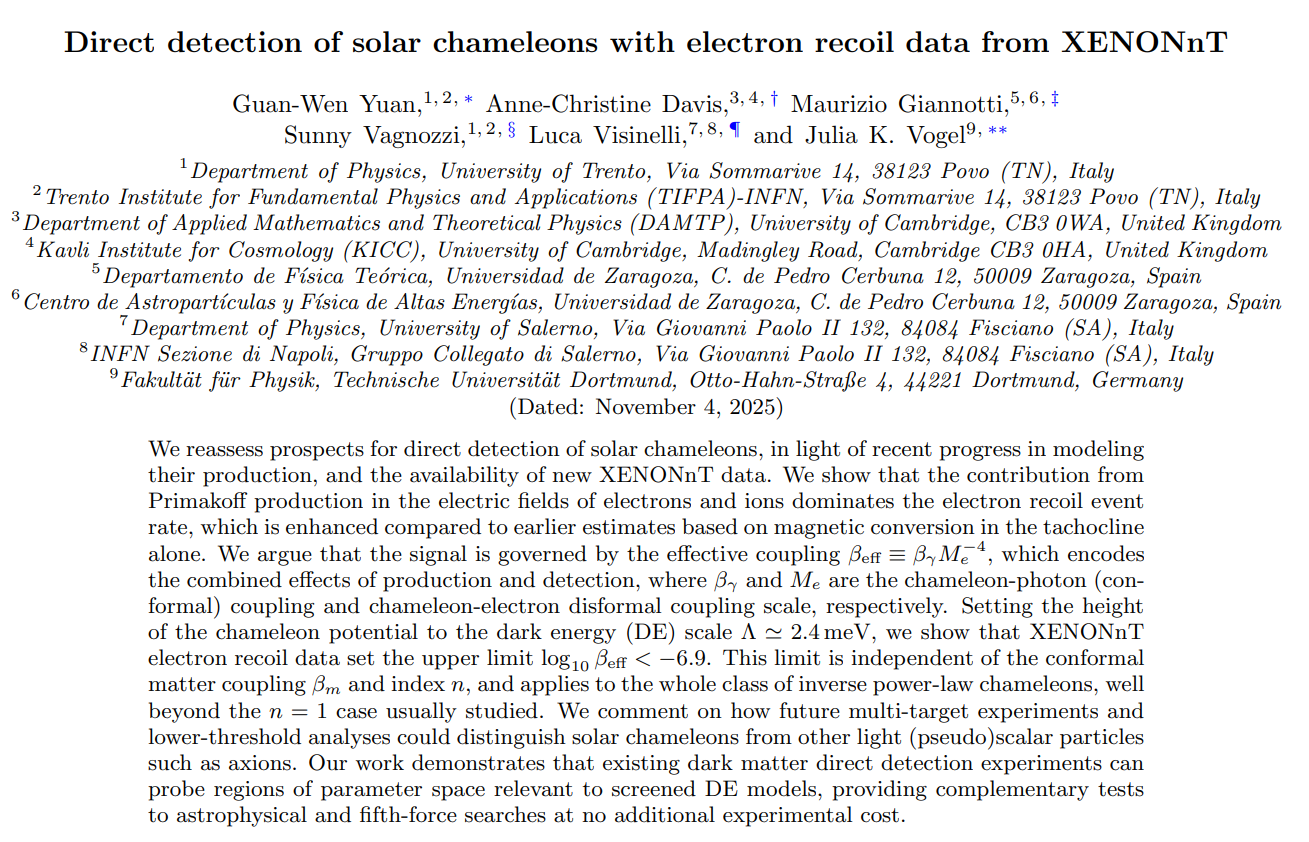
Solar chameleons and XENONnT
Very happy to see my latest paper with Guan-Wen Yuan, Anne Davis, Maurizio Giannotti, Luca Visinelli, and Julia Vogel out on arXiv - kudos to Guan-Wen who did all the heavy lifting! This paper is essentially a merger of two previous papers of mine: in 2021 Luca, Anne, and I argued that dark matter direct detection experiment such as XENON1T could detect chameleons, light particles potentially related to dark energy, produced in the Sun (see paper in PRD), whereas later in 2024 some of us drastically improved the model for solar chameleon production, which was previously grossly incomplete to say the least (see paper in PRD and this earlier news item). What we did here was to combine the tools built in these two papers, applying the results to newer and much more sensitive data from XENONnT, and confirming the extremely important message that terrestrial dark matter experiments are well suited to probe screened dark energy at no extra experimental cost. We clarified various previously unclear points, and derived a new upper limit on a combination of chameleon couplings (specifically the conformal coupling to photons and the disformal coupling to electrons), valid for essentially all values of the chameleon power-law index n, making it one of the most widely applicable chameleon bounds to date. You can read the results in the preprint we just posted on arXiv: 2511.01655.
Miguel Sabogal joins my group!
I’m super excited to welcome my new PhD student Miguel Sabogal to my group! Miguel, who is originally from Colombia, previously did his MSc in Brazil at the Federal University of Rio Grande do Sul under the supervision of my friend and colleague Rafael Nunes, working broadly on tests of fundamental physics from cosmological data: with me, he will keep going in this direction, with an eye in particular to cosmological tensions. Miguel already has an outstanding publication record, with several high-impact, original, and extremely interesting publications, including a PRL. Many of my colleagues I’ve spoken to think of Miguel as the potential future of cosmology in Latin America, and I am excited that he chose to join my group. Welcome Miguel!
Associate Professor
After having passed my tenure evaluation in June, today is officially my first day as (tenured) Associate Professor! Except for more money, more teaching duties, more responsibilities, and my title changing from Dr. to Prof., nothing really changes in my everyday work, which means I’ll still try to get as much research done as possible.
Hawking radiation from regular black holes
New paper with Marco Calzà and Max Rinaldi out today, making it yet one more paper 100% produced within the Theoretical Gravitation and Cosmology Group led by myself and Max! We study the issue of Hawking radiation from regular black holes (BHs): most, if not all, of the regular BH solutions usually studied are non-vacuum solutions, i.e. their Ricci scalar R is non-zero. In this case a possible non-minimal coupling of scalar fields to curvature, strongly motivated by QFT in curved space-time considerations, can become relevant, yet has almost always been ignored. What we showed is that including this non-minimal coupling can drastically alter the resulting Hawking radiation spectrum, even by orders of magnitude, leading to potentially observable effects. You can read our results in the preprint we just posted on arXiv: 2510.12257.

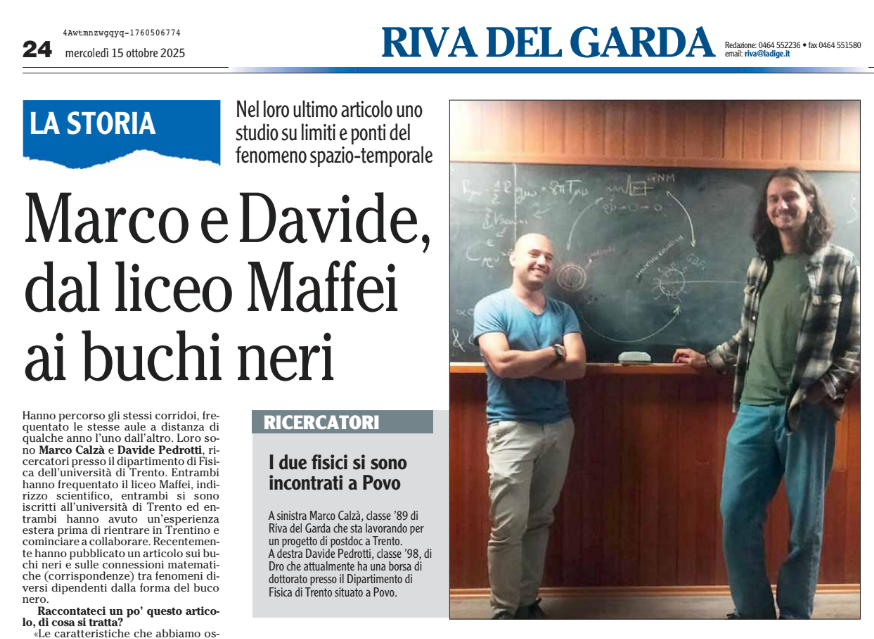
Marco Calzà and Davide Pedrotti are on l'Adige!
Today l’Adige, the main regional newspaper of Trentino-Alto Adige, put out in their printed version (which, I admit, I had to recover from a trash can next to a bar since I was one day late!) an extremely nice piece on Marco Calzà and Davide Pedrotti, their early years (they went to the same high school in Riva del Garda, though during different periods), how their paths crossed in Povo, and their works on black holes (the piece should be visible here). Very nice to see local newspapers giving visibility to our young researchers!
Screened dark energy and non-local quantum correlations paper published in PRD!
My paper with Fabiano Feleppa and Gaetano Lambiase, where we study non-local Bell-type quantum correlations between pairs of entangled particles within screened dark energy models (see this earlier news item), has now officially been published in PRD! The full bibliographic coordinates for the paper are Phys. Rev. D 112 (2025) 084011. Here is the link to the paper.

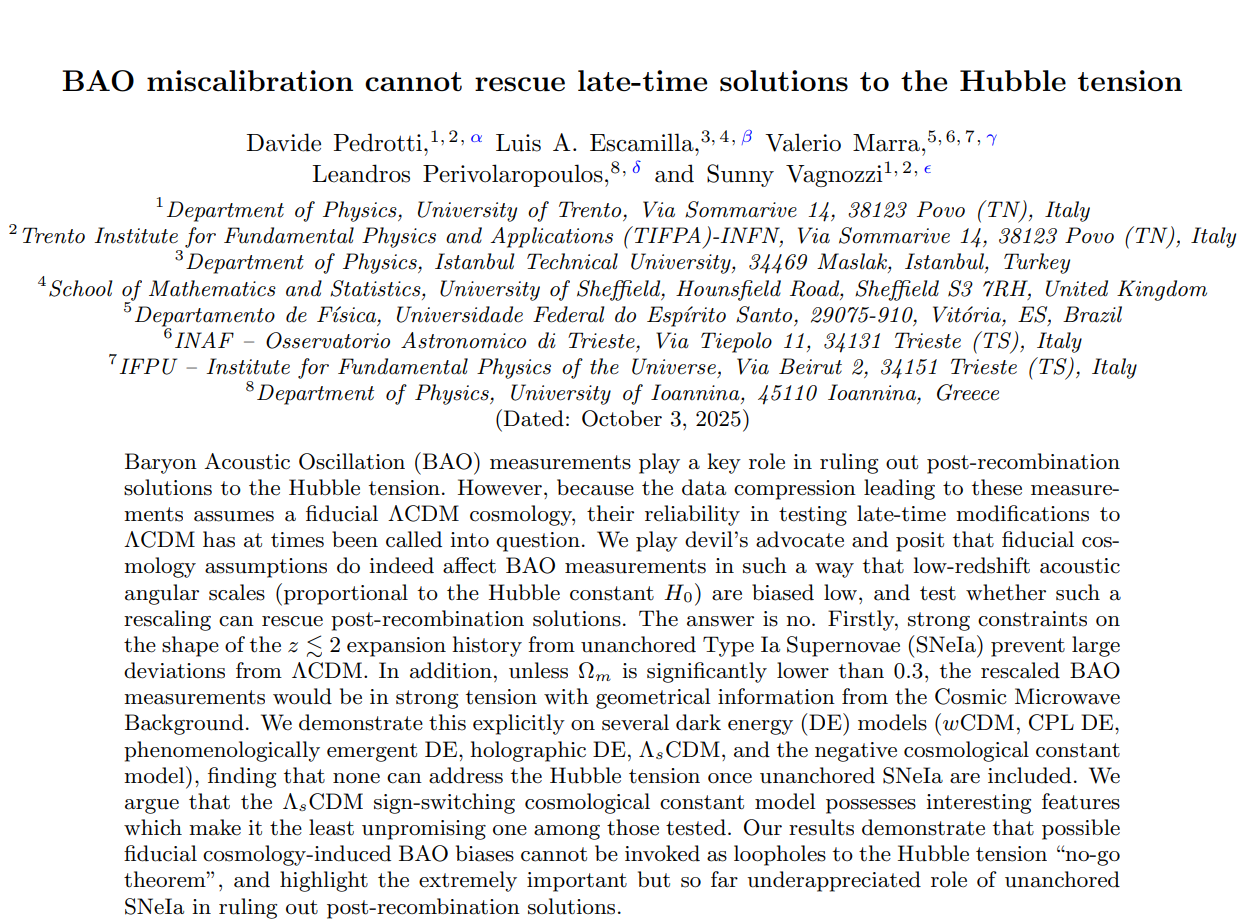
BAO and Hubble tension no-go theorem
I’m extremely excited to finally see my latest paper with Davide Pedrotti, Luis Escamilla, Valerio Marra, and Leandros Perivolaropoulos, finally out on the arXiv - kudos to Davide who did all the heavy-lifting in what I do not hesitate to place among the three most important papers I ever wrote! This paper is about what we could call the “Hubble tension no-go theorem”, which forbids purely post-recombination solutions due to the constraints BAO impose on the product of the sound horizon and the Hubble constant. However, the pipeline from which BAO measurements are obtained requires assuming a fiducial cosmological model, with the choice falling on ΛCDM: many have therefore wondered whether we can trust these measurements when testing late-time modifications to ΛCDM, and this is the most frequently invoked loophole to the no-go theorem. In this work we have played devil’s advocate and showed that, even if BAO measurements were to be grossly (and unrealistically) biased by fiducial cosmology assumptions, this would still not be sufficient to rescue post-recombination solutions to the Hubble tension, primarily because of the extremely tight constraints on the (unnormalized) shape of the expansion history from unanchored SNeIa, whose role in the Hubble tension so far has been underappreciated. You can read our results in the preprint we just posted on arXiv: 2510.01974.
Visit by Zakaria Belkhadria
For the next week and a half we have Zakaria Belkhadria, who recently received his PhD from the University of Cagliari and the University of Geneva, visiting us funded by a CosmoVerse COST STSM grant. He will be working with me and Max Rinaldi on the complementarity between strong-field and cosmological tests of modified gravity. Welcome Zakaria!
Visit by Alex Ganz
For the next three days we have Alex Ganz visiting us from the University of Hannover! Alex is currently a postdoc in the group of Guillem Domènech, and has worked on several topics of interest to our group, such as modified gravity (including mimetic gravity) and gravitational waves. He will be delivering a talk by the title of “Exploring modified gravity theories”. Welcome Alex!
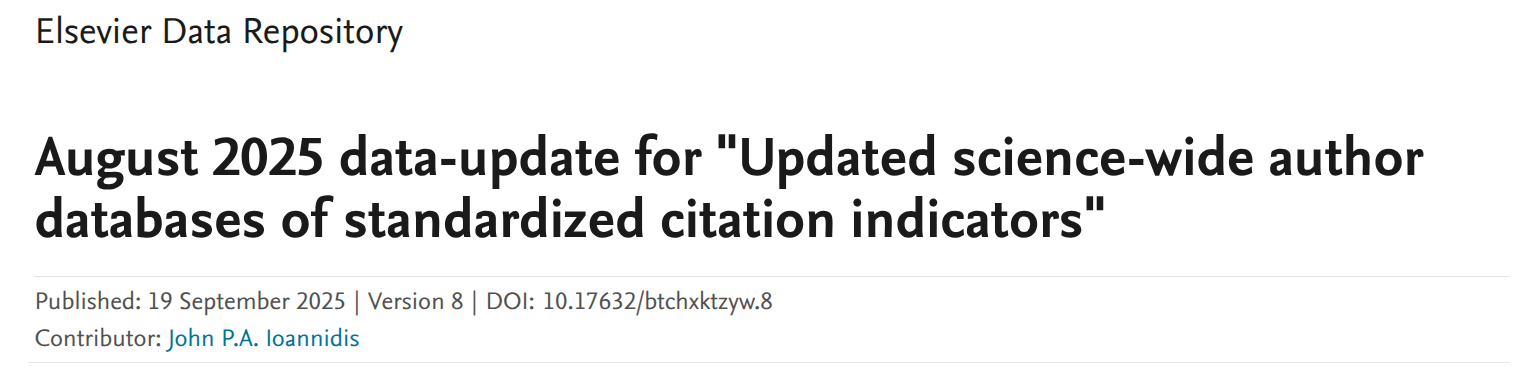
Top 2% scientists (2024 edition)
As with last year, for what it’s worth, it looks like my name appeared in the list of top 2% scientists worldwide, compiled by John Ioannidis at Stanford University, and available here. It seems that for the year 2024 I’ve been ranked 1546th across all fields, and 14th in my area (again looks quite high, perhaps it’s because some Scopus research evaluation tool thinks my main area is Nuclear & Particle Physics rather than Astronomy & Astrophysics), whereas considering my whole career the numbers become 43884th and 749th respectively. Again, all the caveats highlighted previously apply.
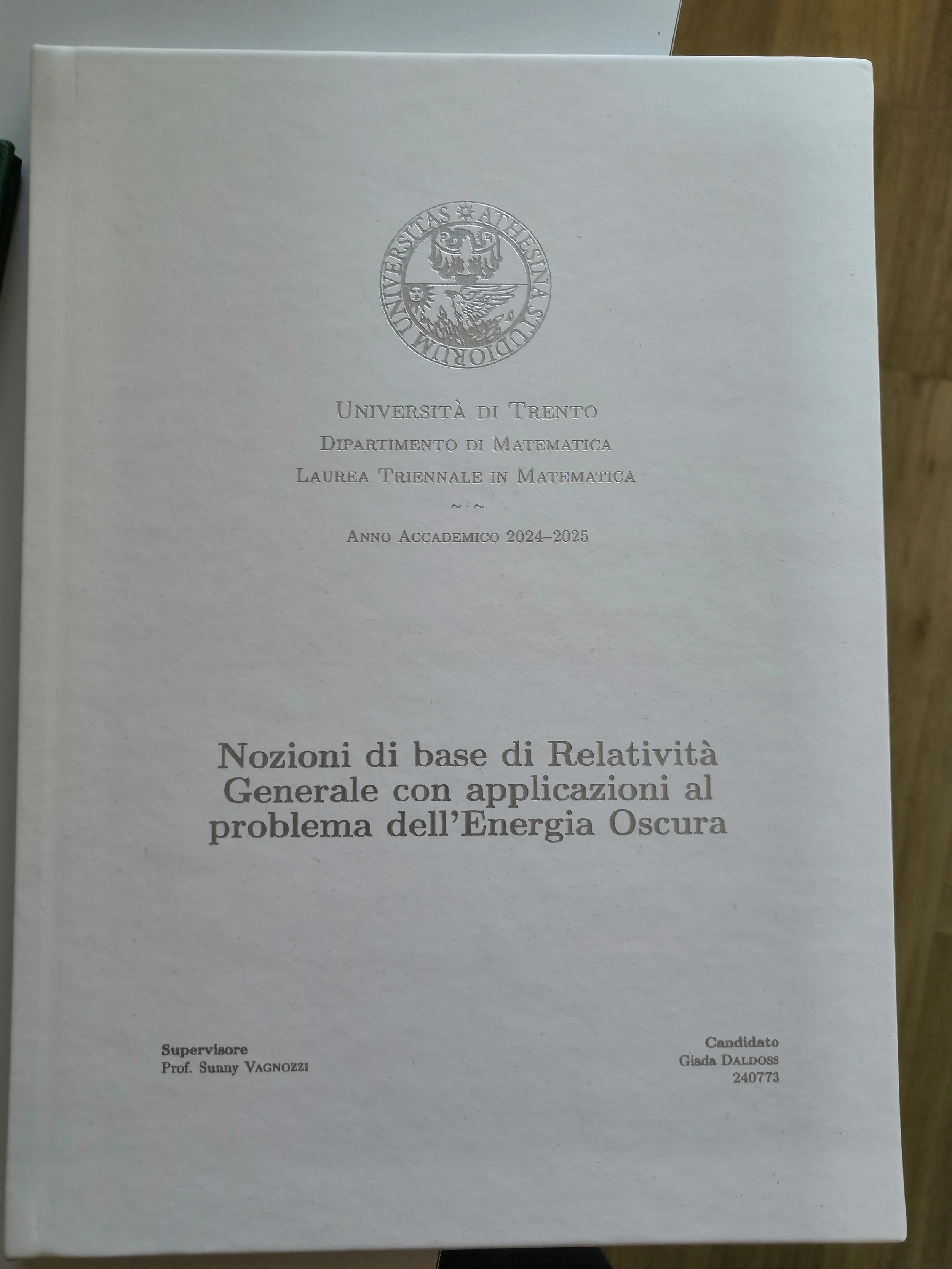
Giada Daldoss' BSc thesis defense
Congratulations to Giada Daldoss, who today successfully defended her BSc thesis (for the BSc degree in Mathematics), by the title of “Nozioni di base di Relatività Generale con applicazioni al problema dell’Energia Oscura”, which translates to “Basic notions of General Relativity with applications to the Dark Energy problem” (with the opponent being Prof. Valter Moretti)! In her thesis which I supervised, Giada introduced basic concepts of General Relativity, before discussing the most important observational indications of Dark Energy.
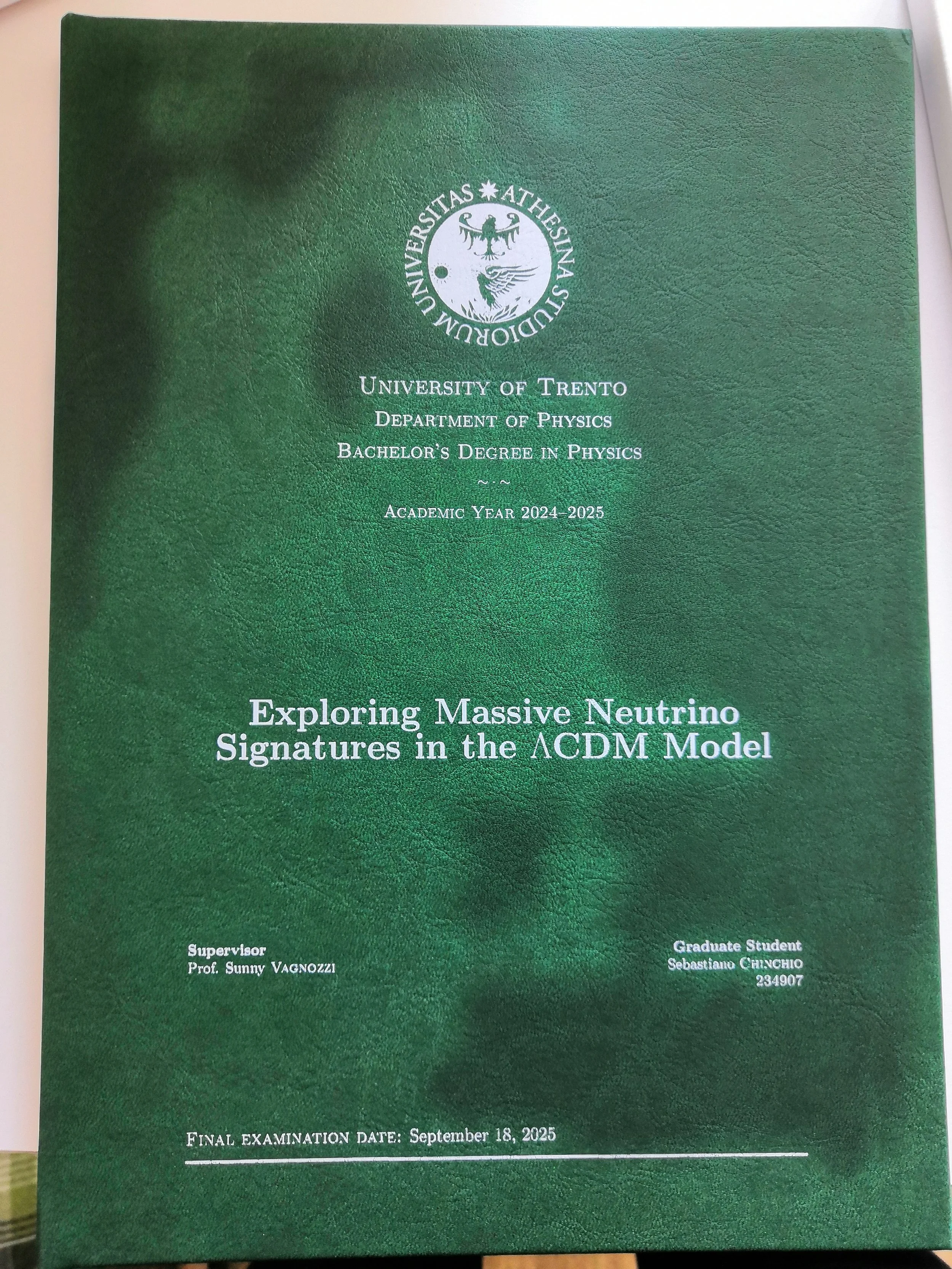
Sebastiano Chinchio's BSc defense
Congratulations to Sebastiano Chinchio, who today successfully defended his BSc thesis, by the title of “Exploring massive neutrino signatures in the ΛCDM model” (with the opponent being Prof. Albino Perego), thus becoming the first BSc student to graduate under my supervision! In his thesis which I supervised, Sebastiano reviewed and showed the effects of neutrino masses on the main cosmological observables (CMB and matter power spectrum), a work which was very far from trivial for a BSc student.
Visit by Enrico Specogna
For the next two days we have Enrico Specogna visiting us from the University of Sheffield! Enrico is currently a PhD student working with Eleonora Di Valentino on several topics of interest to our group, such as cosmological tensions, massive neutrinos, inflation, and modified gravity. He will be delivering a talk by the title of “Modified gravity & friends vs current CMB data”. Welcome Enrico!
Screened dark energy and non-local quantum correlations paper accepted in PRD!
My paper with Fabiano Feleppa and Gaetano Lambiase, where we study non-local Bell-type quantum correlations between pairs of entangled particles within screened dark energy models (see this earlier news item), has been accepted for publication without changes in PRD! You can read the preprint version of our paper on arXiv: 2508.18448.
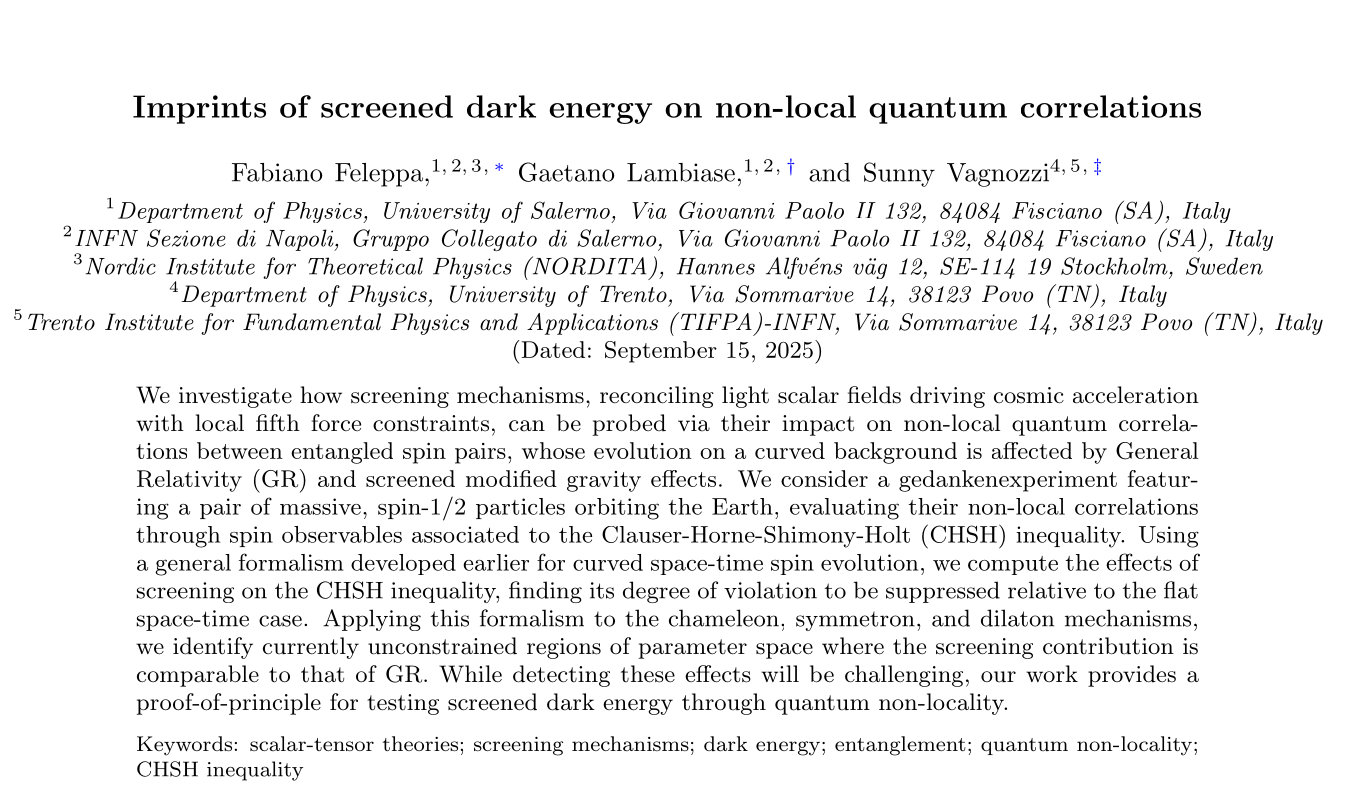
Screened dark energy and non-local quantum correlations
Very happy to see my latest preprint with Fabiano Feleppa and Gaetano Lambiase from the University of Salerno finally out on the arXiv - kudos to Fabiano who did all the heavy-lifting and an excellent job! We focused on so-called screened dark energy/modified gravity models, where the would-be fifth force associated to a new light scalar degree of freedom responsible for cosmic acceleration is dynamically suppressed through, you guessed it, screening mechanisms, such as the chameleon, symmetron, and dilaton ones. We showed that these mechanisms can leave their imprint in non-local Bell-type correlations between pairs of entangled particles, leading to potential new observational signatures in currently unconstrained regions of parameter space. These will not be easy to detect, but if anything that’s a challenge for future generations of experimentalists! You can read our results in the preprint we just posted on arXiv: 2508.18448.

CosmoVerse white paper published in PDU!
The CosmoVerse white paper, produced within the CosmoVerse COST Action and discussing in detail the state-of-the-art regarding a number of observational tensions in cosmology (see this earlier news item), has now officially been published in PDU! The full bibliographic coordinates for the paper are Phys. Dark Univ. 49 (2025) 101965. Here is the link to the paper (which is published Open Access).

Zakaria Belkhadria wins STSM grant to visit Trento
Congratulations to Zakaria Belkhadria, who recently received his PhD from the University of Cagliari and the University of Geneva, and who was awarded a COST short-term scientific mission (STSM) grant within the CosmoVerse COST Action, which will fund his short visit to the University of Trento in October! Zakaria will be working with Max Rinaldi and myself on strong-field tests of modified gravity models which show promise in the Hubble tension context.
Leonardo Comini’s MSc defense
Congratulations to Leonardo Comini, who today successfully defended his MSc thesis, by the title of “Testing cosmological models with JWST high-redshift galaxies” (with the opponent being Prof. Albino Perego), receiving the final grade of 110/110! In his thesis which I supervised, Leonardo studied the possibility of testing cosmological models (focusing on dark energy) in a statistically robust way using high-redshift galaxies from JWST, focusing both on photometric and spectroscopic samples, and finding that despite the relatively large error bars some of these samples can indeed give interesting cosmological information. We are planning to write up our results in a paper relatively soon, so stay tuned for more!

Primordial regular black holes (part 3)
Very happy to have posted my first new paper in about 10 months (excluding the CosmoVerse white paper) today (after several months spent applying for grants and teaching, with very little research done), together with Marco Calzà, Davide Pedrotti, and Guan-Wen Yuan, making it yet another paper entirely produced within my group! This is the third chapter in the series on primordial regular black holes as potential dark matter candidates (see the earlier part 1 and part 2, both published in PRD - paper 1 and paper 2), where we consider a completely different metric, which we call the Zhang-Lewandowski-Ma-Yang (ZLMY) BH, after the names of the authors which first proposed it here. This BH has completely different properties with respect to the ones we had considered earlier: it has a very strong theoretical foundation within an effective canonical (loop) quantum gravity framework which addresses the important issue of general covariance, whereas from the phenomenological perspective it is one of the few BHs which is hotter with respect to the Schwarzschild BH. We find that this leads to a smaller asteroid mass window where ZLMY PBHs can account for all the DM, smaller relative to Schwarzschild PBHs of course, a result which completely reverses the trend we found earlier, when the asteroid mass window was significantly enlarged and evaporation constraints could in principle be bypassed. You can read our results in the preprint we just posted on arXiv: 2507.02396.
