Today we have the pleasure of hosting Carsten van de Bruck, visiting us from Sheffield! Carsten is currently a Professor at the University of Sheffield, and is a recognized expert on theoretical cosmology, particularly for what concerns modified gravity models for inflation and dark energy, and their observational tests. He will not be delivering a talk, but is here as one of the external opponents for Chiara Cecchini’s PhD defense (which, by the way, was outstanding - you can find her PhD thesis on scale-invariant inflationary models here). Welcome Carsten!
Beyond ΛCDM with JWST
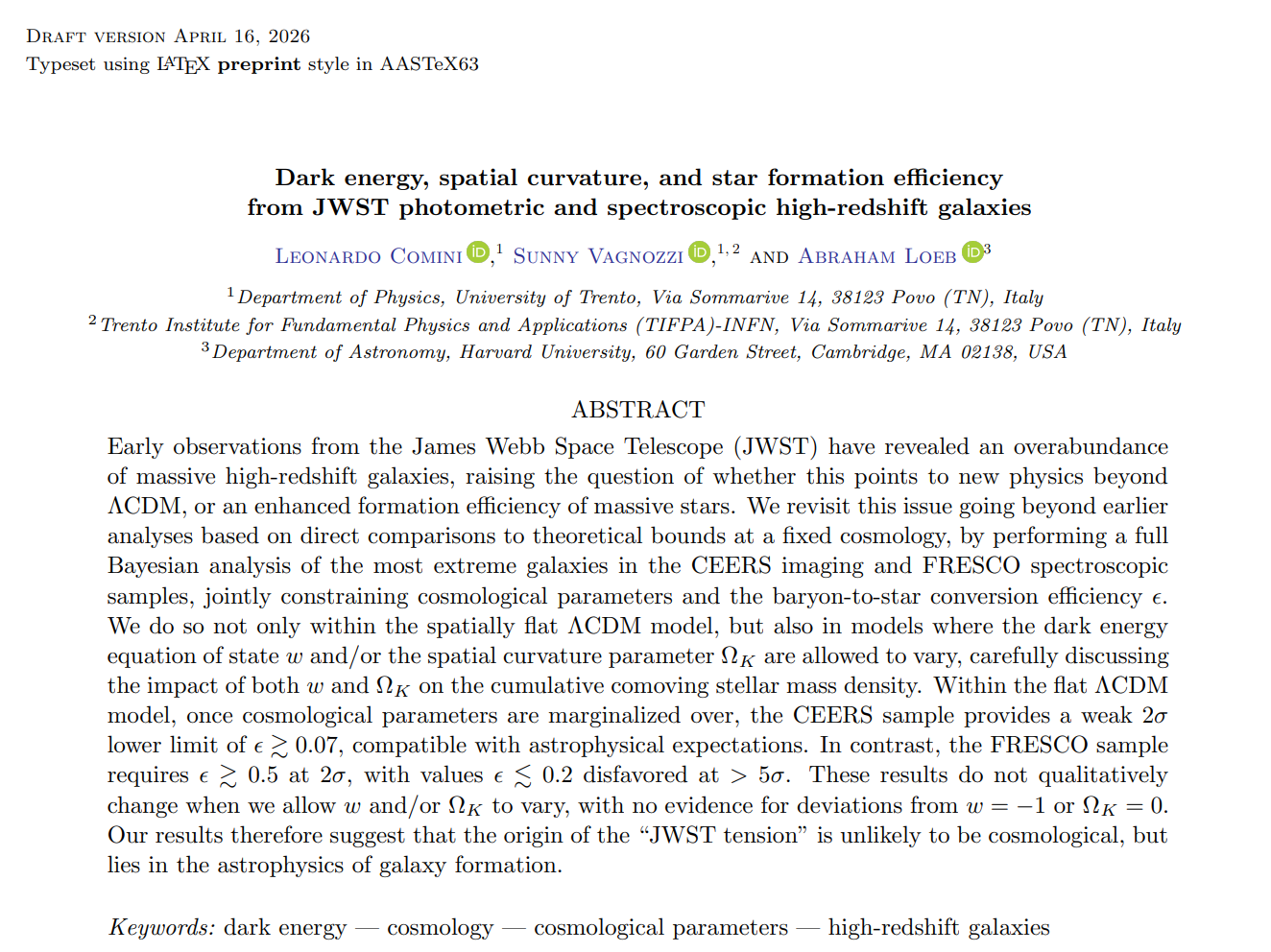
I’m very happy to see my latest paper with my former MSc student Leonardo Comini and Avi Loeb out on arXiv - congratulations to Leonardo who did a significant part of the work, in what is basically the result of his MSc thesis! This work is basically an extension of Mike Boylan-Kolchin’s 2023 paper arguing that early JWST photometric data put significant pressure on the ΛCDM model. We basically asked the question of how this result changed if: 1) a proper Bayesian analysis was carried out, 2) considering also models beyond ΛCDM (e.g. models with a free equation of state or spatial curvature), and 3) using also spectroscopic data which is more reliable? The answer is that carrying out this analysis photometric data actually no longer requires an unusually high star formation efficiency, unlike (surprisingly) spectroscopic data, with the results not changing significantly in models beyond ΛCDM: the conclusion is that the origin of the “JWST tension” is likely astrophysical rather than cosmological. You can read the results in the preprint we just posted on arXiv: 2604.13866.
Multi-field early dark energy
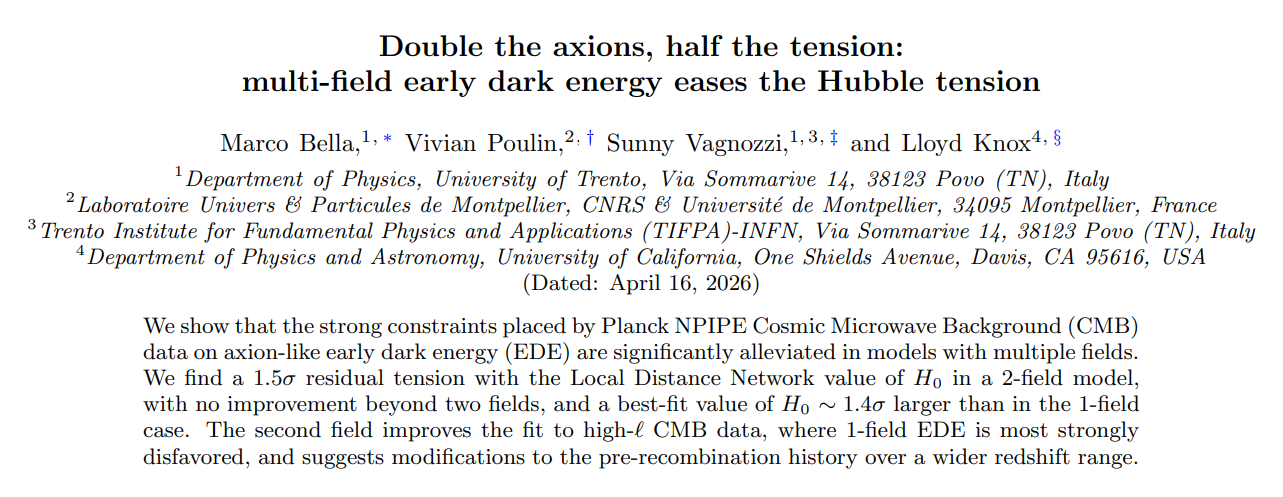
I’m extremely excited to see my latest paper with my outstanding MSc student Marco Bella, Vivian Poulin, and Lloyd Knox out on arXiv - congratulations to Marco who did basically all the work, in what is essentially the result of his MSc thesis! The canonical 1-field axion early dark energy (EDE) model which Vivian and collaborators developed a few years ago faces extremely tight constraints when confronted against Planck PR4 CMB data. In this work we asked ourselves: what happens if we introduce more than 1 axion, a scenario which for instance can be strongly motivated by the string axiverse? The answer is that having 2 axions can significantly help, basically halving the residual Hubble tension even when confronted against Planck PR4 CMB data, whose fit is drastically improved by the fact that the modifications to the expansion history now span a wider redshift range, including the epoch closer to recombination (although, interestingly, having more axions does not seem to improve these results). You can read the results in the preprint we just posted on arXiv: 2604.13535.
Visit by Antonio Racioppi
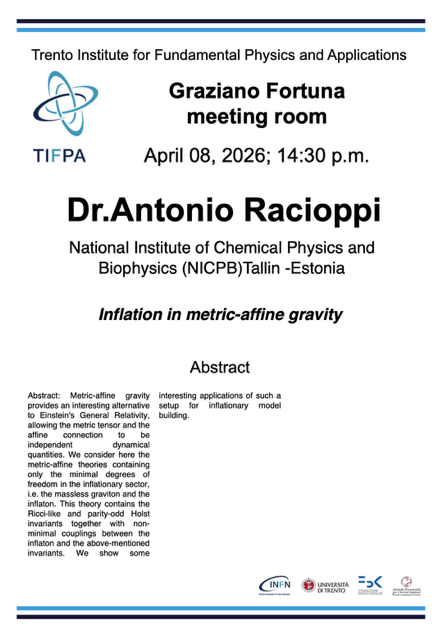
Today we have the pleasure of hosting Antonio Racioppi, visiting us from Tallinn! Antonio is currently a senior researcher at the National Institute of Chemical Physics and Biophysics (NICPB) in Tallinn, working especially on the construction of inflationary models beyond General Relativity. He will be delivering a talk by the title of “Inflation in metric-affine gravity”. Welcome Antonio!
Marco Bella’s MSc defense
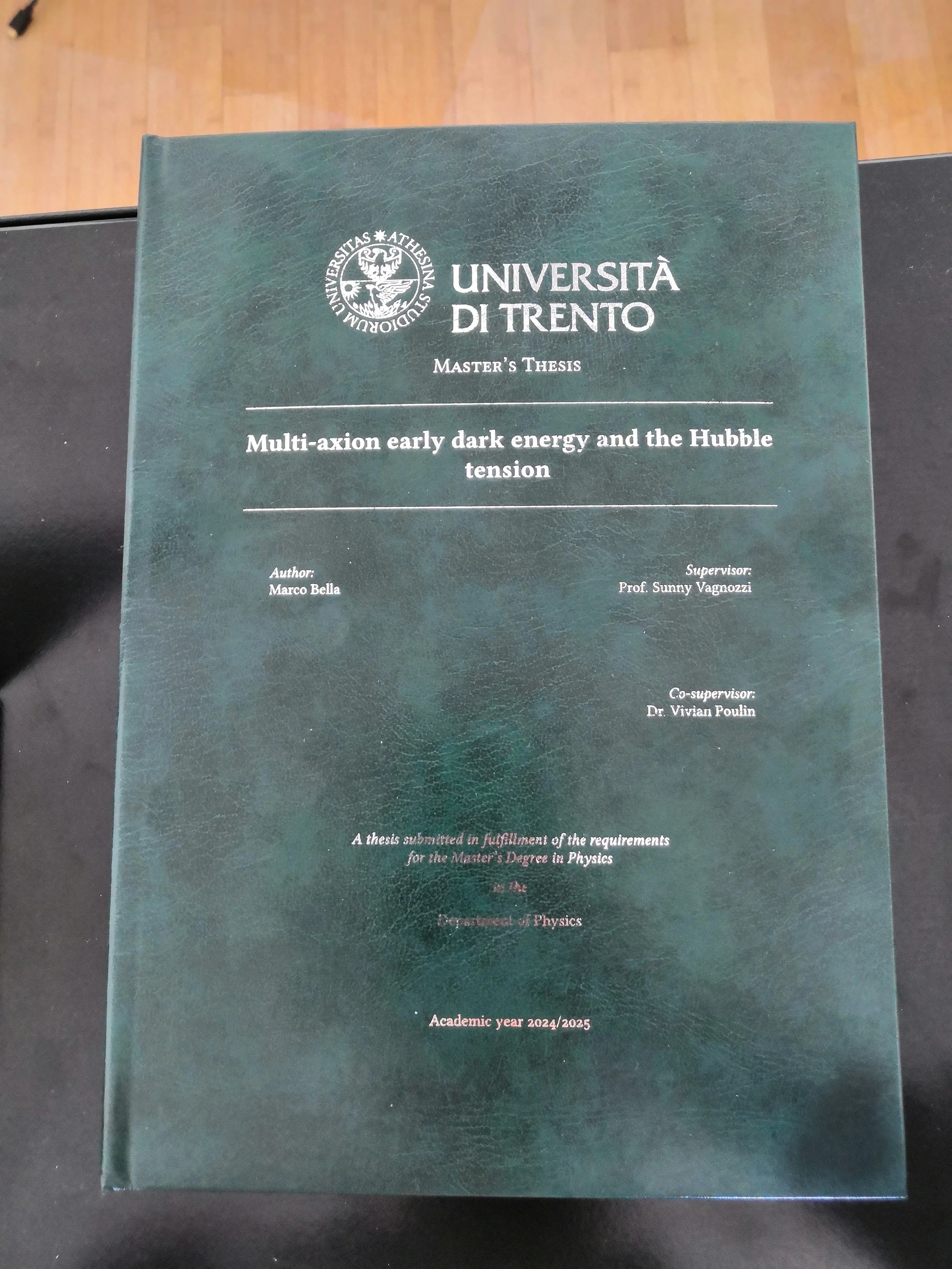
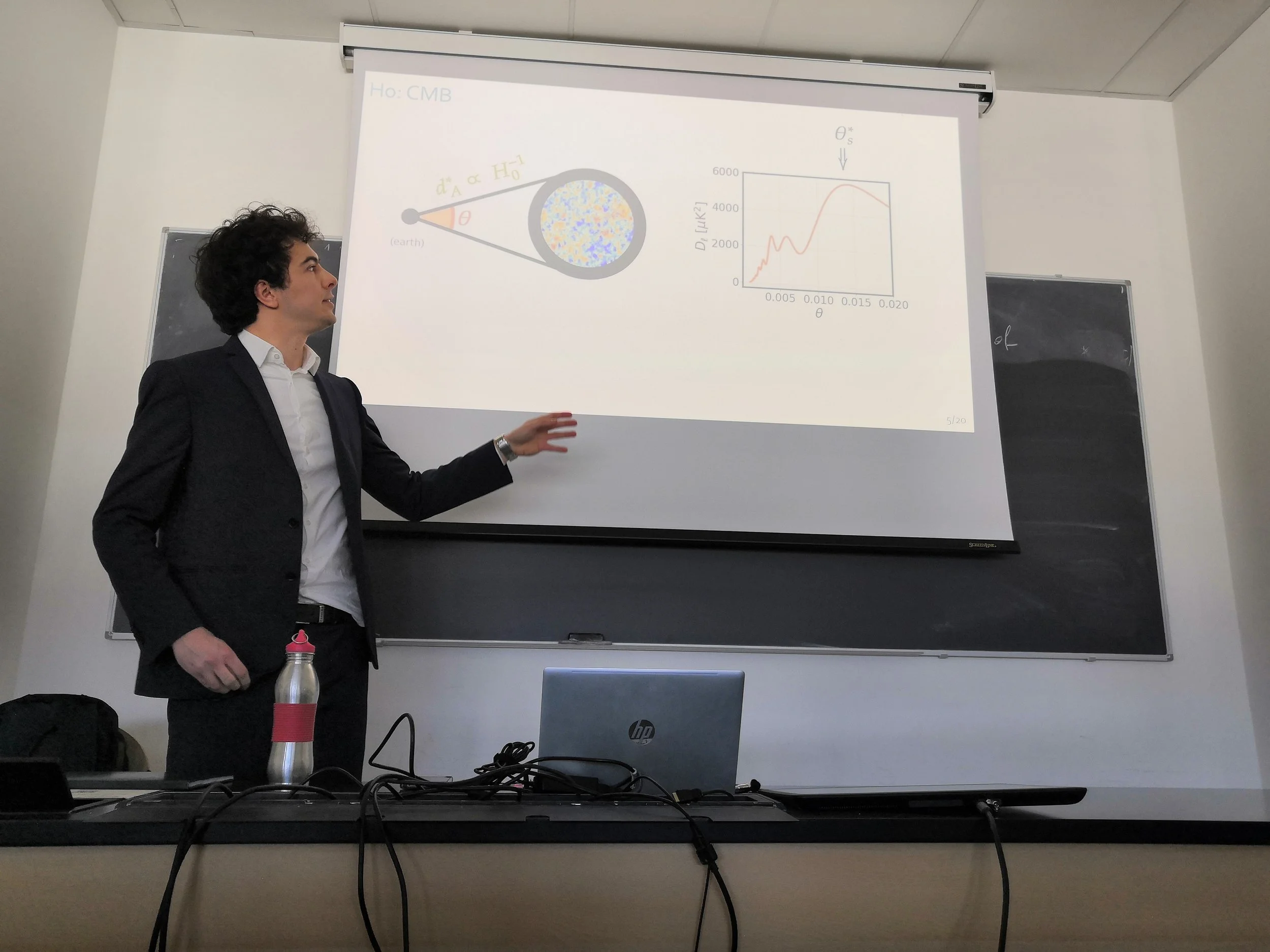
Congratulations to Marco Bella, who today successfully defended his MSc thesis, by the title of “Multi-axion early dark energy and the Hubble tension” (with the opponent being Prof. Albino Perego)! Marco’s defense was absolutely outstanding, and he received top grades and honours, i.e. 110 e Lode (with this being the fourth 100 e Lode for my MSc students, after Davide Pedrotti, Giovanni Piccoli, and Mattia Scotto). In his thesis which I supervised together with Vivian Poulin, Marco studied multi-field axion early dark energy models, with the goal of seeing whether they can further improve over the vanilla early dark energy model in the context of the Hubble tension (as a spoiler, the answer is yes, and we are preparing a paper on the topic to appear soon, so stay tuned!), while developing and publicly releasing the mAxiCLASS Boltzmann solver. Marco will be starting his PhD later this year at UC Davis, where he will be working with Lloyd Knox. During the same day, I also served as opponent for Sara Marini and Jesa Crapella, respectively MSc students of Prof. Albino Perego and Prof. Alessandro Roggero, who discussed theses on binary neutron star mergers and non-superfluid neutron stars.
Alessandro La Sala’s BSc defense
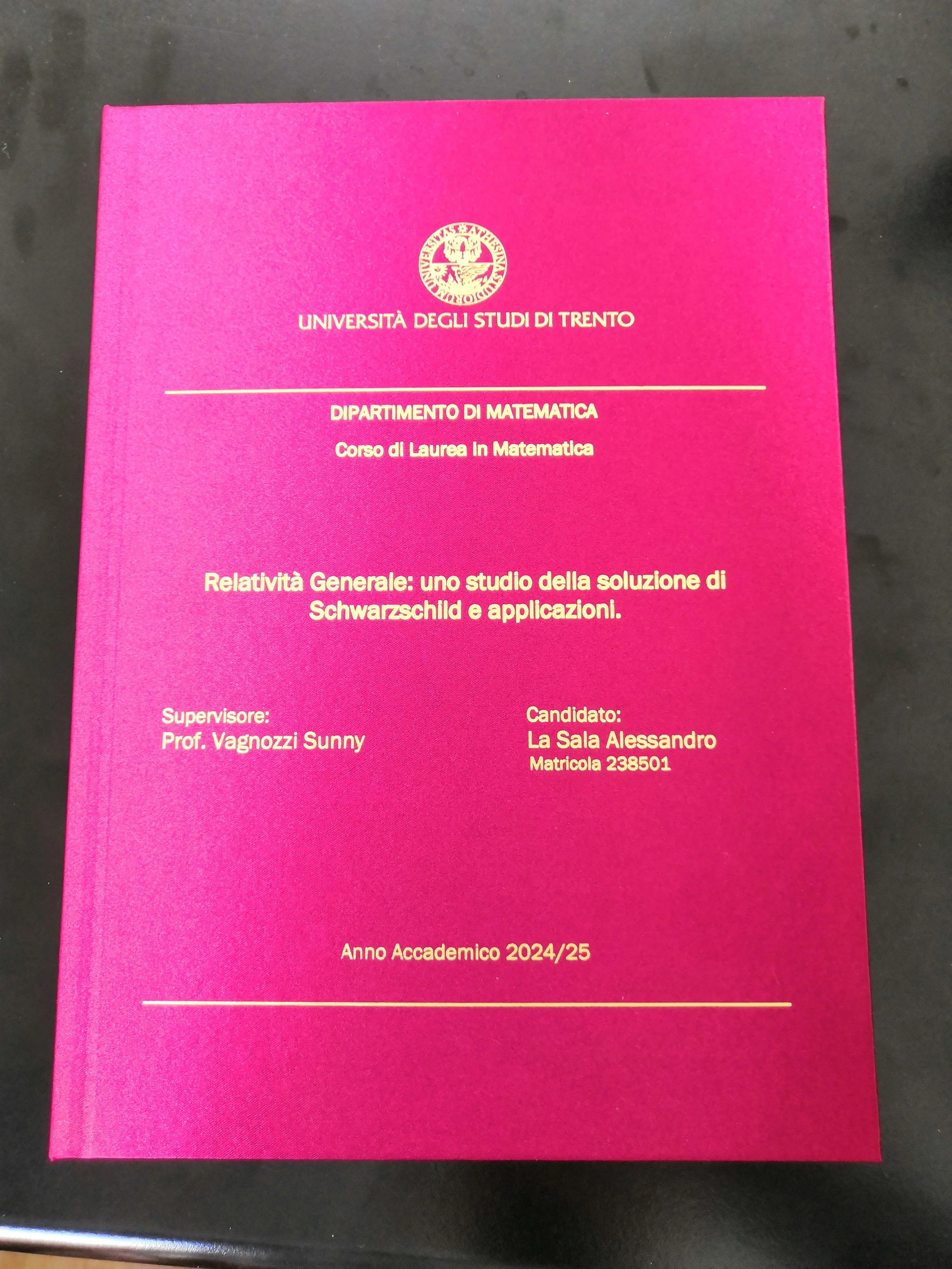
Congratulations to Alessandro La Sala, who today successfully defended his BSc thesis (for the BSc degree in Mathematics), by the title of “Relatività Generale: uno studio della soluzione di Schwarzschild e applicazioni”, which translates to “General Relativity: a study of the Schwarzschild solution and applications” (with the opponent being Prof. Sonia Mazzucchi)! In his thesis which I supervised, Alessandro discussed some basic aspects of General Relativity, before turning to features of the Schwarzschild solution.
Andrea Di Pompeo's BSc defense
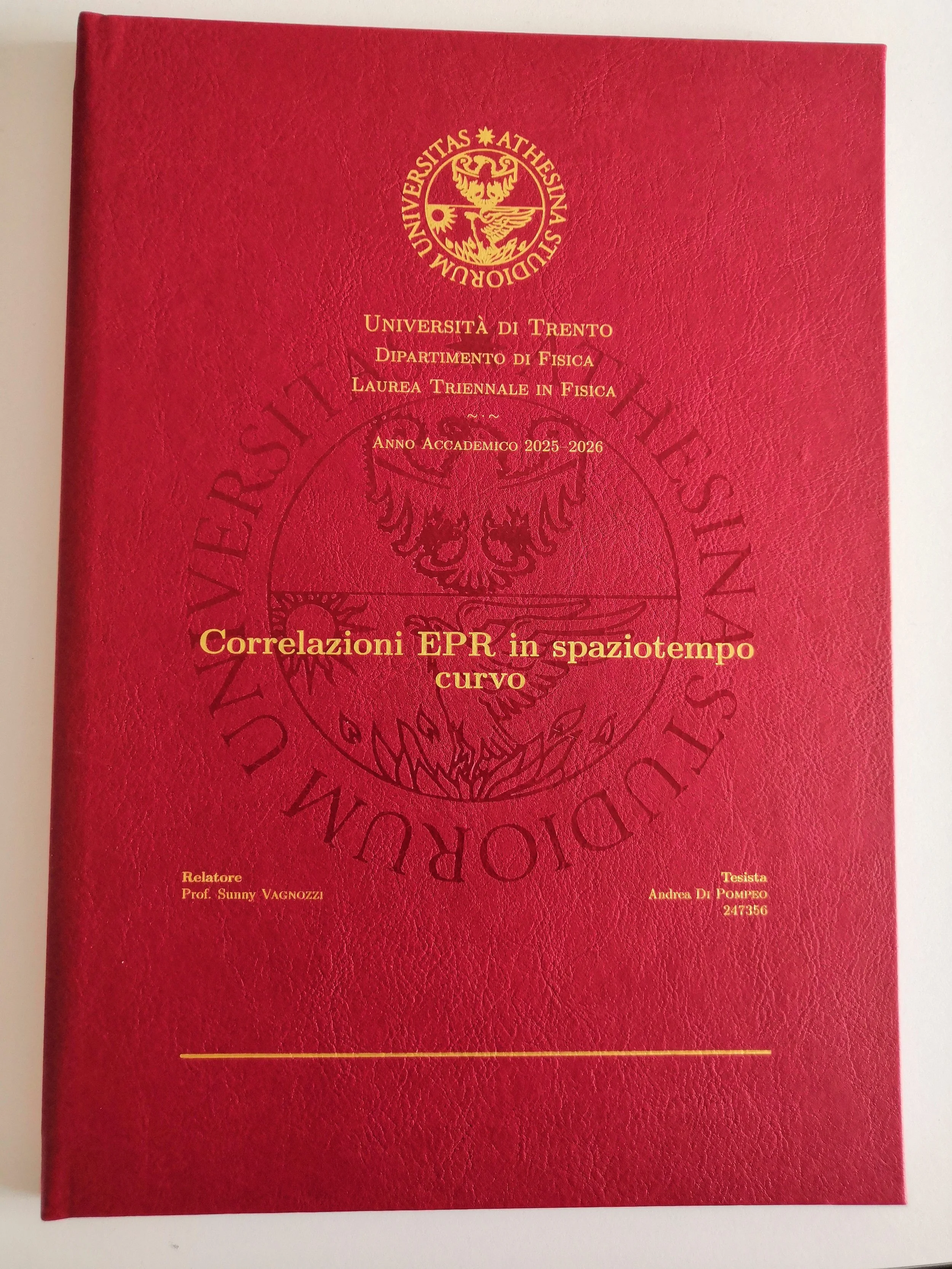
Congratulations to Andrea Di Pompeo, who today successfully defended his BSc thesis, by the title of “Correlazioni EPR in spaziotempo curvo”, which translates to “EPR correlations in curved spacetime” (with the opponent being Prof. Max Rinaldi)! In his thesis which I supervised, Andrea discussed the effects of spacetime curvature on non-local quantum correlations between entangled pairs of spins, with a focus on Bell-type correlations (and in particular CHSH correlations), a work far from trivial for a BSc student.
Tonale Winter school organization
As of today, I’ve officially entered the organizing team for the Tonale Winter School, a well-known cosmology winter school addressed to advanced MSc students, PhD students, and junior postdocs, which started in 2007 and takes place in Passo del Tonale, Italy. I am taking over Max Rinaldi, who has stepped down after being an organizer for several years. I myself attended the school as a student in 2014 and as a lecturer in 2023. I’m really excited to get started, and stay tuned for more updates on the 2026 edition!
Visit by Kevin Croker
For the rest of the month we have the great pleasure of hosting Kevin Croker, currently an Assistant Research Scientist at Arizona State University. Kevin is especially well known for his work on cosmologically coupled black holes. He will be delivering a few lectures on the topic, specifically on constrained variations and their impact on cosmological dynamics. Welcome Kevin!
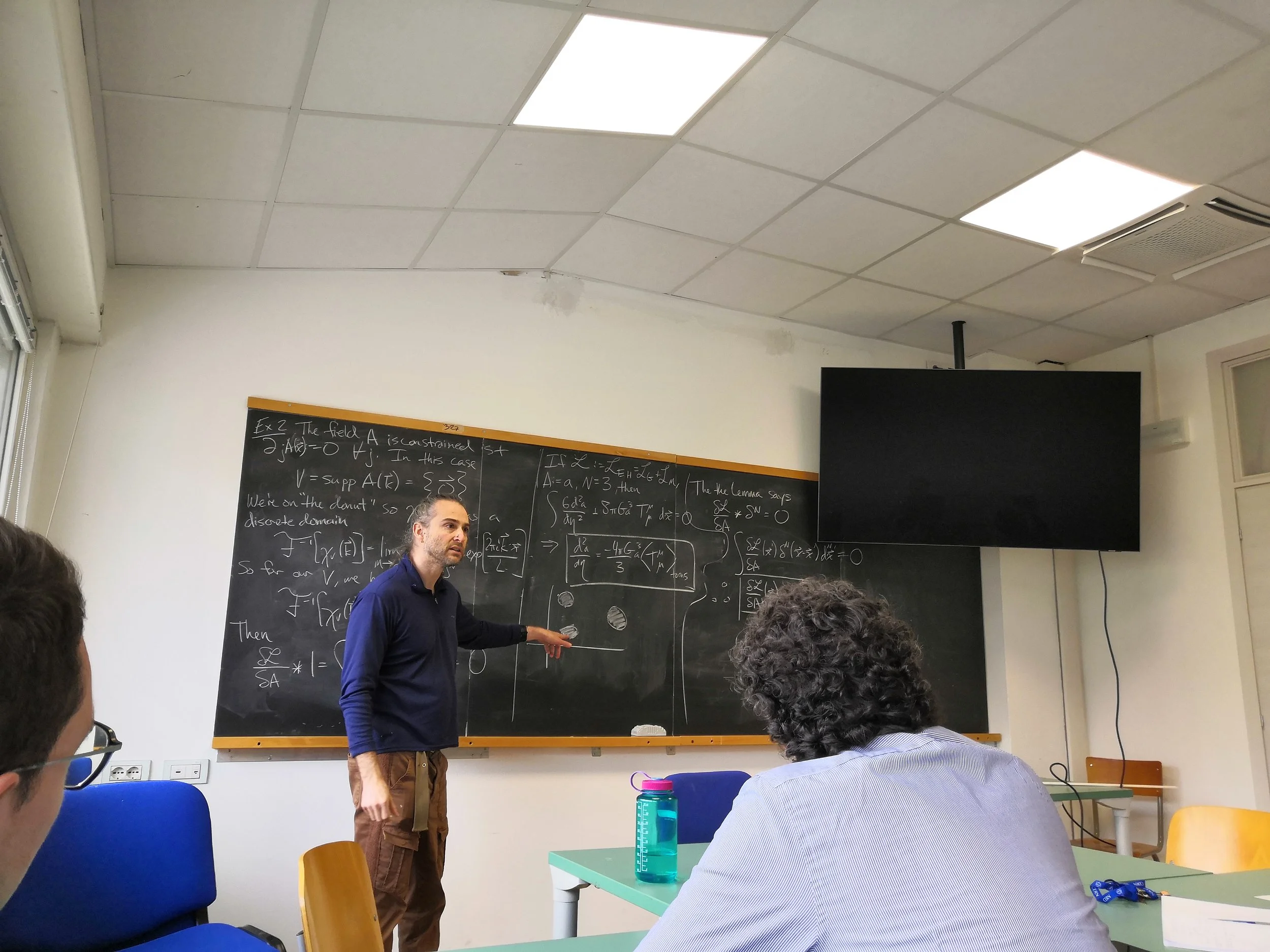
Teaching restarts today
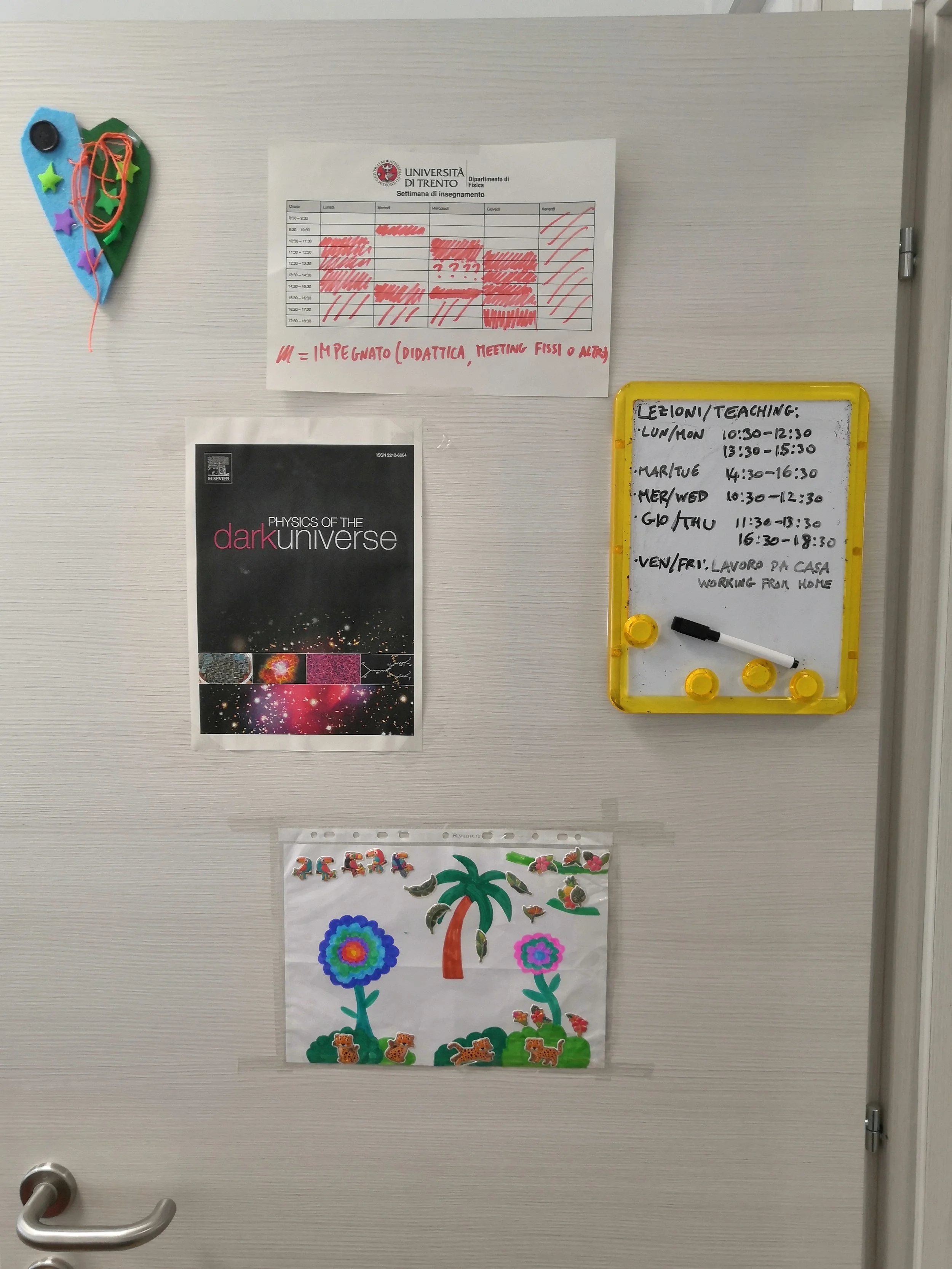
Today my teaching duties restart once more! For the rest of the semester I’m looking at an extremely busy schedule (as detailed on my office door) where I’ll once again be teaching Classical Thermodynamics for the Mathematics BSc, Relativity for the Physics BSc, and Modern Cosmology for the Physics MSc. During these busy months I’m basically guaranteed to do almost no research, so hopefully my collaborators will understand 🤪 As in previous years, all my teaching material will be made publicly available on the English and Italian versions of my teaching page.
BAO and Hubble tension no-go theorem paper published in PRD!
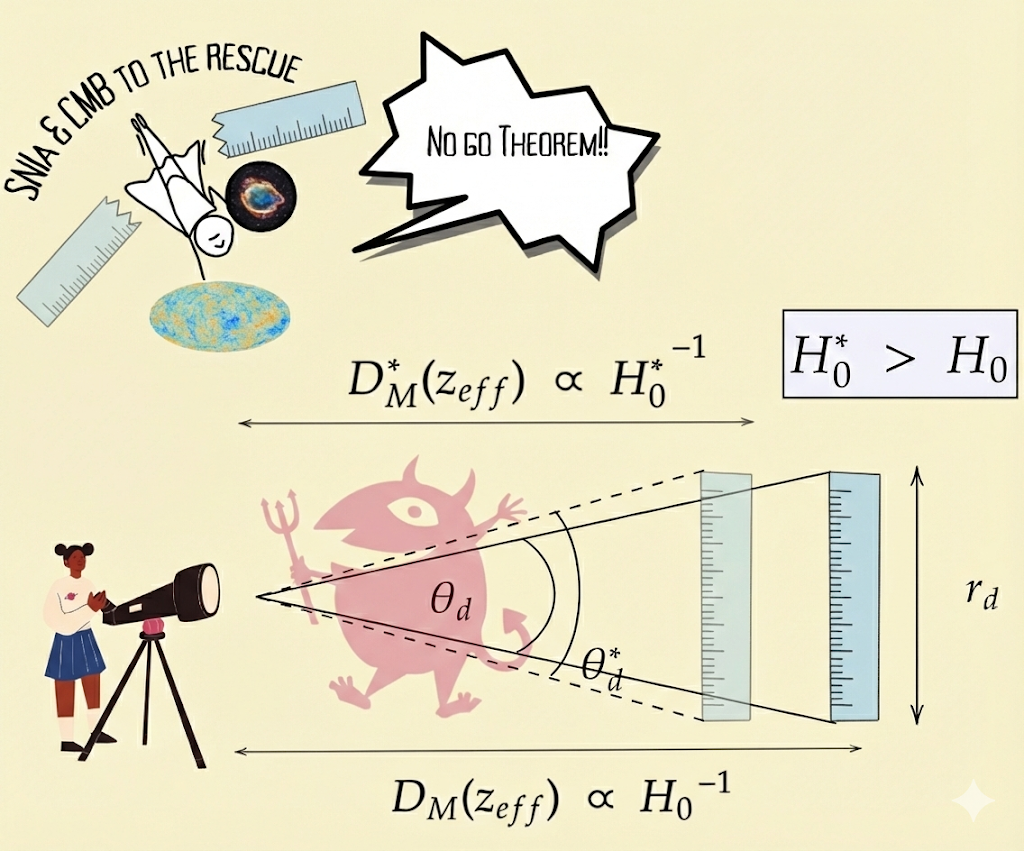
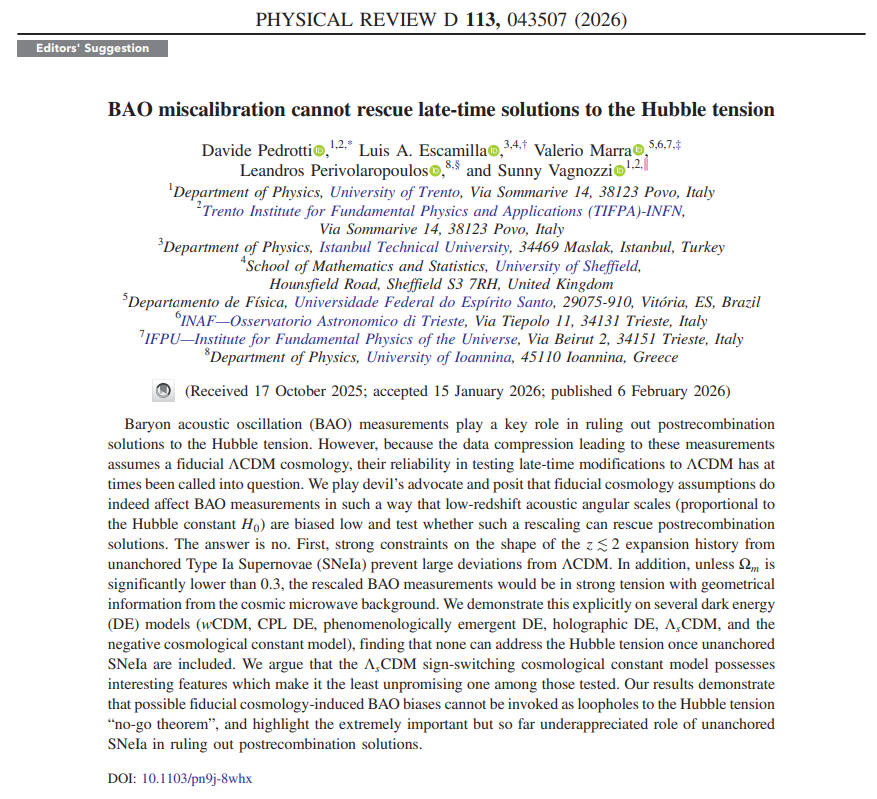
My paper with Davide Pedrotti, Luis Escamilla, Valerio Marra, and Leandros Perivolaropoulos, where we show that the “Hubble tension no-go theorem” forbidding purely post-recombination solutions is robust against a possible miscalibration of BAO measurements, while highlighting the very important role of unanchored SNeIa (see this earlier news item), has now officially been published in PRD, where it has been selected as an Editors’ Suggestion (see this earlier news item)! The full bibliographic coordinates for the paper are Phys. Rev. D 113 (2026) 043507. Here is the link to the paper (which is published Open Access).
Edvig Selimaj joins my group!
Today Edvig Selimaj officially joins my group, and will be carrying out his Master’s thesis under the supervision of myself and Miguel Sabogal. We plan to work on non-parametric reconstructions of the expansion history in light of state-of-the-art cosmological datasets, and then apply a number of machine learning methods to these reconstructions to learn more about dark energy. Welcome Edvig, and I’m looking forward to our work together!
Gruppo 2003
As of today, I’m honored to be a member of Gruppo 2003! This is a group which brings together some of the most influential Italian scientists (including for instance Giorgio Parisi, here is the full list of members), with the aim of improving the far from ideal situation of scientific research in Italy. The group is also responsible for the online journal Scienza in Rete, and holds a certain political influence. Needless to say I’m honored to have been invited to join the group, and I hope I’ll be able to give my contribution to improving the state of research in Italy!
Congratulations to Marco Bella!
Congratulations to Marco Bella, who has been offered a PhD position at UC Davis, where he is expected to work with Lloyd Knox! Congratulations Marco, good luck with this upcoming chapter, I can think of few people in whose hands you’d be better placed than Lloyd!
BAO and Hubble tension no-go theorem paper selected as Editors' Suggestion in PRD!
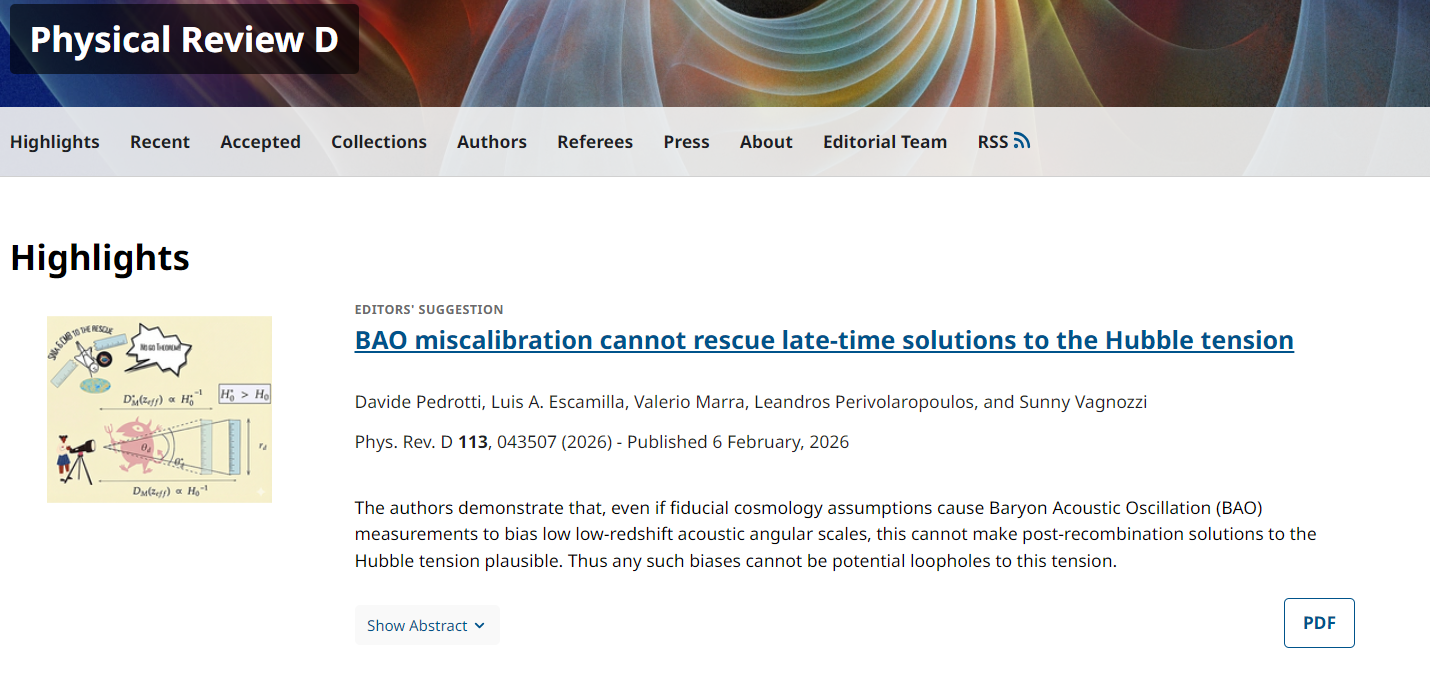
My paper with Davide Pedrotti, Luis Escamilla, Valerio Marra, and Leandros Perivolaropoulos, on the implications of a possible BAO miscalibration for the Hubble tension (see this earlier news item), recently accepted for publication in PRD, has also been selected as an Editors’ Suggestion! These make up a small fraction of outstanding papers judged by PRD’s Editors as being particularly important, interesting, and well written, and are highlighted on the journals’ homepage. Great news for a paper which I do not hesitate to place among the top 3 most important papers I ever wrote!
BAO and Hubble tension no-go theorem paper accepted in PRD!
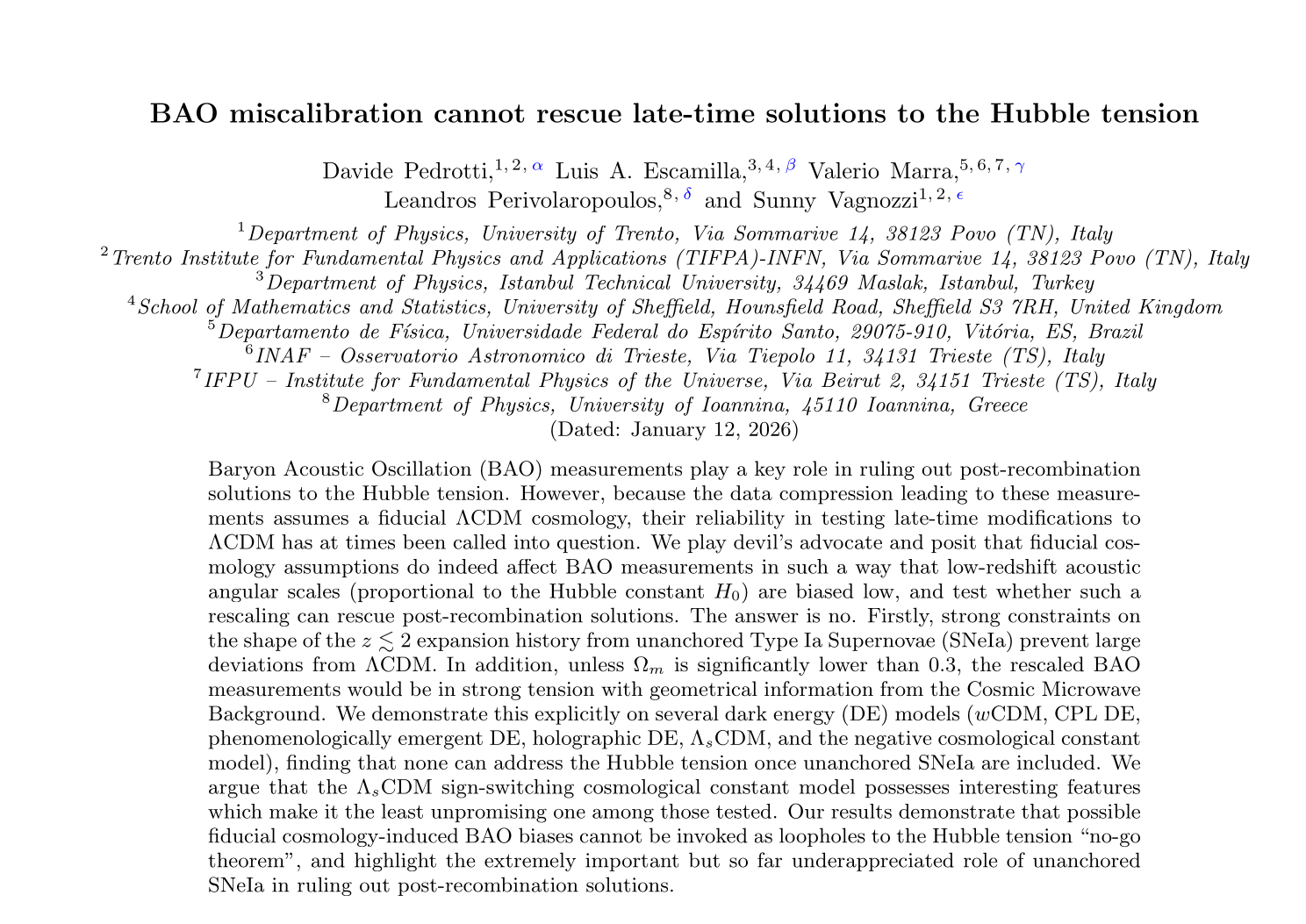
My paper with Davide Pedrotti, Luis Escamilla, Valerio Marra, and Leandros Perivolaropoulos, where we show that the “Hubble tension no-go theorem” forbidding purely post-recombination solutions is robust against a possible miscalibration of BAO measurements, while highlighting the very important role of unanchored SNeIa (see this earlier news item), has been accepted for publication in PRD! Compared to the earlier version there were very minor changes to Fig. 5 and Fig. 10. You can read the preprint version of our paper on arXiv: 2510.01974.
L'Adige piece on influential researchers in Trento
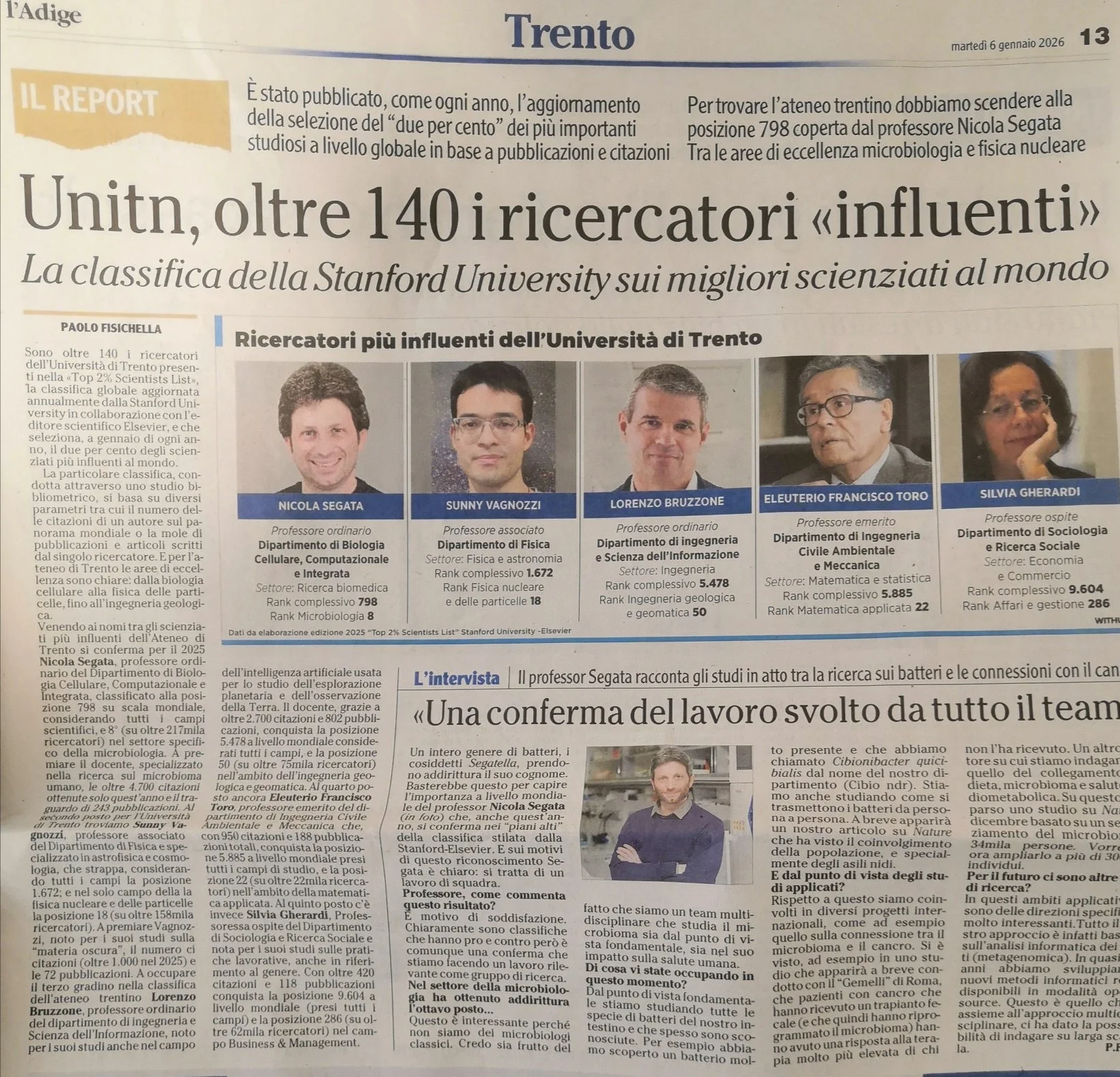
Today l’Adige, the main regional newspaper of Trentino-Alto Adige, wrote a piece (available only in their printed version) on the most influential researchers at the University of Trento, motivated by Ioannidis’ top 2% scientists “ranking” (covered, with all the very relevant caveats, in this earlier news item - the specific ranks should really be taken with a cauldron of salt!), with my name among those explicitly highlighted together with Nicola Segata, Lorenzo Bruzzone, Eleuterio Francisco Toro, and Silvia Gherardi. A scan of the article is available here.
Primordial regular black holes (part 3) paper published in PRD!
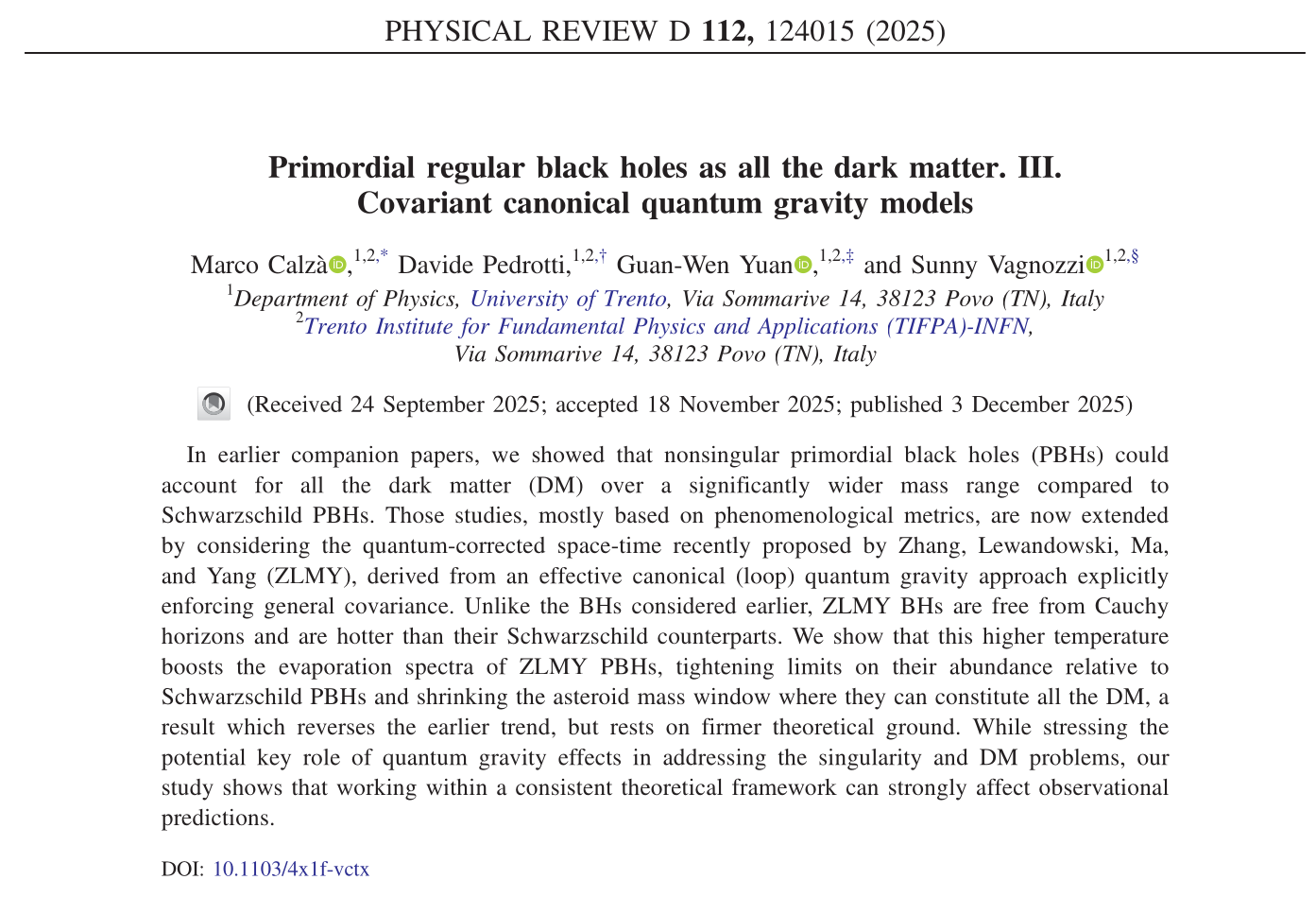
My paper with Marco Calzà, Davide Pedrotti, and Guan-Wen Yuan, which represents the third chapter in the primordial regular black holes saga (see this earlier news item), has now officially been published in PRD! The full bibliographic coordinates for the paper are Phys. Rev. D 112 (2025) 124015. Here is the link to the paper.
Visit by Francesca Vidotto
Today we have the pleasure of hosting Francesca Vidotto, visiting us from Madrid! Francesca is currently a senior researcher at IEM-CSIC, and is a recognized expert on (loop) quantum gravity. She will be delivering a talk by the title of “All you wanted to know about black hole remnants and never dared to ask”. Welcome Francesca!
Hawking radiation from regular black holes paper published in PRD!
My paper with Marco Calzà and Max Rinaldi, where we study Hawking radiation from regular black holes in the presence of a non-minimal scalar-curvature coupling (see this earlier news item), has now officially been published in PRD! The full bibliographic coordinates for the paper are Phys. Rev. D 112 (2025) 104055. Here is the link to the paper.